
Margin vs Markup: The Difference That Costs You Money
Both describe profit. The difference is what that profit gets measured against.
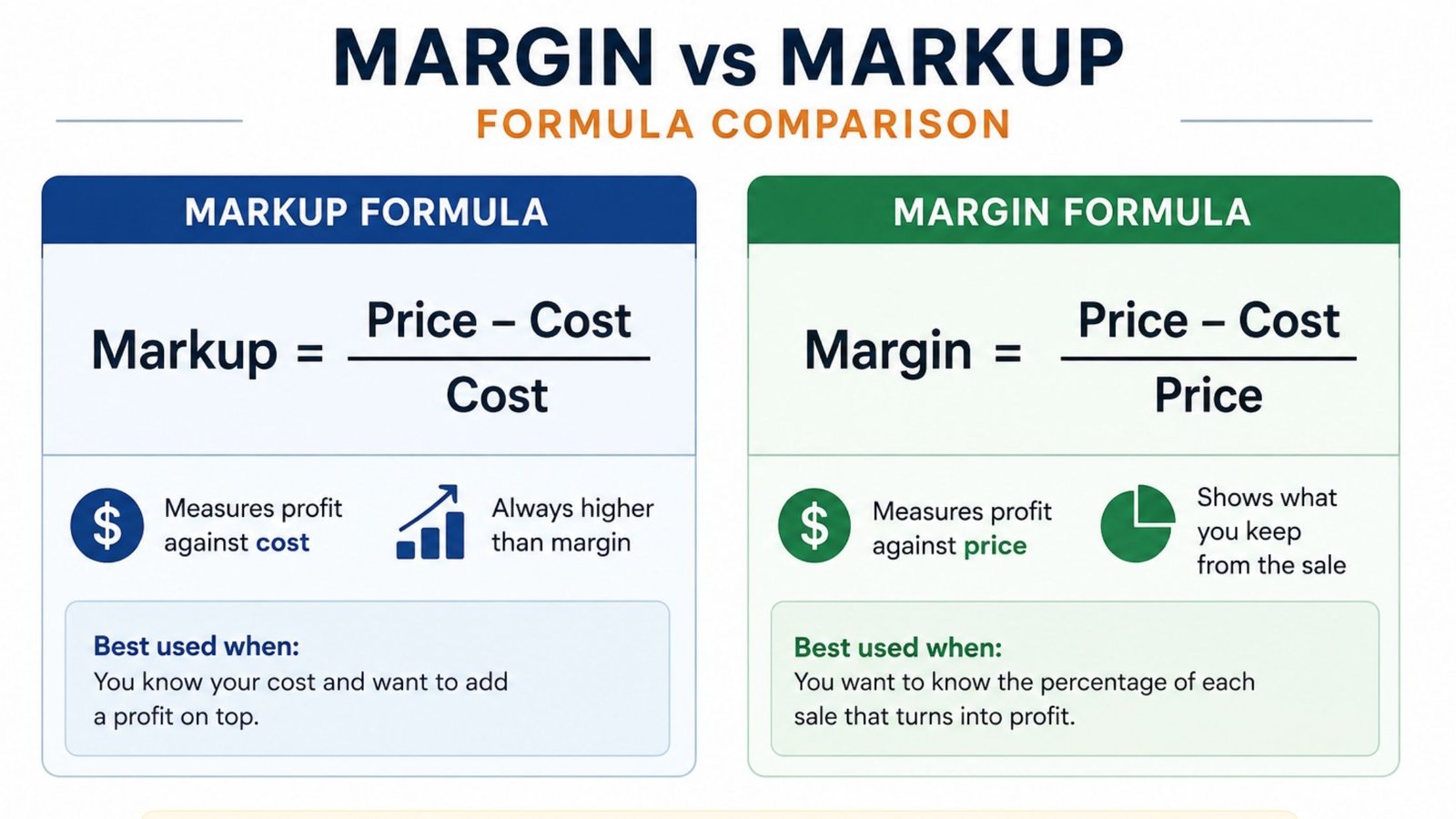
Markup measures profit against your cost, what you paid to deliver the work. Margin measures profit against your price, what the client actually paid you. According to Corporate Finance Institute, a lot of people use the terms markup and gross margin interchangeably. They are different. The gap between the two percentages grows as either one increases.
Same dollars of profit. Different denominator. That’s the whole confusion in one sentence.
The Math Behind Each One
Two formulas. They only differ in what sits on the bottom:
Markup = (Price − Cost) ÷ Cost
Margin = (Price − Cost) ÷ Price
Cost stays the same in both. Price stays the same in both. Only the denominator changes. That alone is enough to make the two percentages meaningfully different for the exact same job.
Because price is always higher than cost on a profitable job, markup is always the bigger number of the two. If someone tells you “we run a 50% margin” and someone else tells you “we run a 50% markup,” they are not describing the same profitability. Mixing them up in a client quote or an internal spreadsheet is where real money leaks out.
Worked Example: Same Job, Two Different Percentages
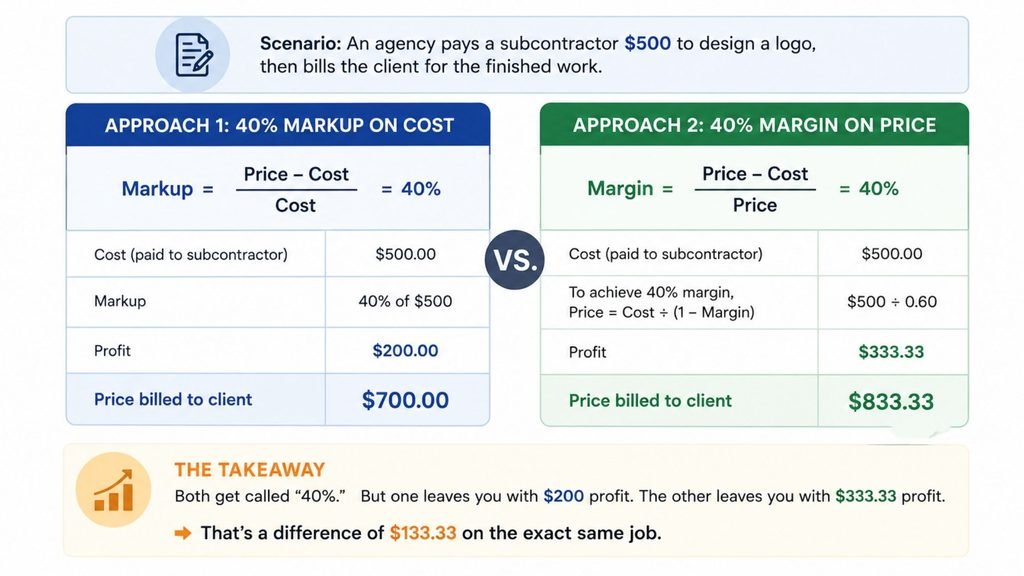
Say an agency pays a subcontractor $500 to design a logo, then bills the client for the finished work.
| Approach | Formula | Result |
| 40% markup on cost | $500 × 1.40 | Price = $700, profit = $200 |
| 40% margin on price | $500 ÷ (1 − 0.40) | Price = $833.33, profit = $333.33 |
Both numbers get called “40%.” One of them puts $200 in the agency’s pocket. The other puts $333.33 in the agency’s pocket, a difference of $133.33 on a single job. Multiply that gap across a year of subcontracted work and it stops being a rounding error and starts being real revenue either left on the table or accidentally given away, depending on which direction the confusion runs.
Converting Between Them
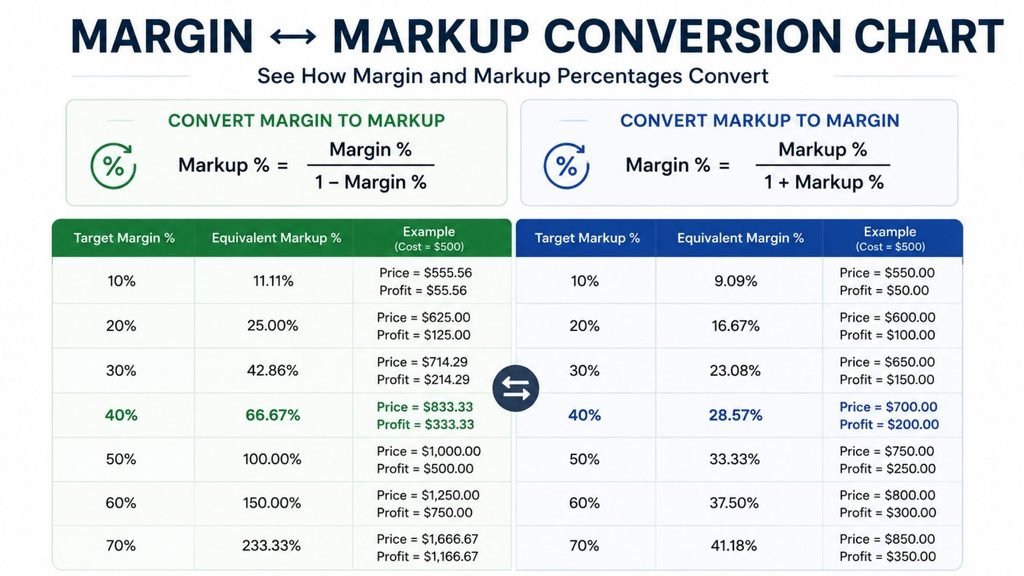
If you already know one percentage and need the other, the conversion formulas do the work directly, no need to rebuild the price from scratch.
Markup % = Margin % ÷ (1 − Margin %)
Margin % = Markup % ÷ (1 + Markup %)
A 40% margin converts to a 66.7% markup. A 40% markup converts to a 28.6% margin. Neither direction is “wrong.” The problem only shows up when a freelancer or agency thinks they’re setting one and is actually setting the other, usually because a client, a competitor or an old spreadsheet used the word loosely.
Where This Mix-Up Actually Costs Money
This isn’t just an accounting technicality. It shows up in ordinary freelance and agency situations:
- Subcontracting. You pay a specialist $60 an hour and bill the client for their time. “I add 25%” and “I keep a 25% margin” produce two different bill rates, not the same one.
- Reselling materials or licenses. You buy $400 of stock assets or a print run and pass the cost to the client. A real 30% margin on that pass-through is $400 ÷ 0.70, not $400 plus 30%, which lands well short of it.
- Retainer and package pricing. A monthly retainer priced to hit a target margin needs a different number than one priced with a flat markup on estimated costs, especially once scope creep starts eating into the hours behind that retainer.
- Quoting from a competitor’s number. If a competitor mentions their “50% profit,” there’s no way to know from that alone whether they mean margin or markup. Pricing your own work to match theirs without asking which one they meant can put you meaningfully off from where you intended to land.
- Scaling a rate card across a team. A solo freelancer who mentally tracks the difference can absorb the confusion without much damage. Once an agency has several people quoting projects from the same rate card, one person quietly using markup where the card intended margin creates inconsistent profitability across the whole team. It often isn’t caught until a quarterly review.
What Margin Should You Actually Aim For?
There’s no single correct number, since it depends heavily on the type of work and how much gets passed through to subcontractors or materials. As a general planning range, aggregated from small-business finance sources covering professional services:
| Type of work | Typical healthy margin |
| Freelance service work (your own labor) | 30-50% |
| Agency work with in-house staff | 25-40% |
| Subcontracted or pass-through work | 15-30% |
| Reselling materials, licenses or ad spend | 10-25% |
Pass-through and resold costs typically carry thinner margins than your own direct labor, since there’s less room to add value on something you’re simply routing through your invoice.
Which One Should You Set First: Margin or Markup?
For pricing decisions, start with margin, not markup. Margin ties directly to what actually lands in the business after a job is done, which is the number that determines whether you can cover overhead, save for slow months and still call the work worthwhile. Markup is a useful tool for getting to that price when you know your cost. But it’s a means to an end, not the target itself.
A practical sequence looks like this: decide the margin you need on a given type of work, based on the benchmark table above and your own overhead. Convert that margin to the equivalent markup using the formula from the previous section. Apply the markup to your known cost to land on the price you actually quote. Working in that order keeps the number you care about, margin, in the driver’s seat instead of an afterthought you check once the invoice is already sent.
Check Both Numbers in One Step
Most calculators, including the ones reviewed for this article, ask you to pick one, markup or margin, then calculate from there. That’s how the confusion keeps happening in the first place, since picking the wrong one at the start means every number after it is off.
nemin.io’s Margin Calculator works differently. Plug your own cost and price into the calculator. It returns both numbers at once, so there’s no need to decide in advance which one you meant. If you’re quoting a client and want to hit a specific margin target, see your margin and markup side by side before sending the number, not after.
This matters most right after you’ve set an hourly rate. If you calculated the hourly rate formula from our last guide, that rate assumes your own labor and overhead. The moment a project includes subcontractors, materials or licensed assets on top of your labor, the margin question comes back into play separately from the rate question. Treating them as the same calculation is exactly the mistake this article is about.
Common Mistakes That Come From Confusing the Two
- Assuming a 50% markup means a 50% margin. It doesn’t. A 50% markup is only a 33.3% margin, a meaningful gap on any job of real size.
- Quoting a margin target but pricing with a markup formula. These produce different prices for the same cost. Only one of them actually hits the target you stated.
- Not distinguishing pass-through costs from your own labor. A single blended margin across both hides which part of the job is actually profitable.
- Copying a competitor’s stated “profit percentage” without asking which one they mean. The same number means two very different things depending on the denominator.
- Never checking both numbers before sending a quote. A margin that looks fine in isolation can still be a markup that’s out of step with what subcontractors or materials actually cost.
- Building a rate card once and never revisiting the margin behind it. Costs for subcontractors, software and materials shift over time. A markup that produced a healthy margin a year ago can quietly erode if the underlying costs moved and the price never did.
FAQs
Is a 50% markup the same as a 50% margin?
No. A 50% markup means adding half the cost on top, which works out to a 33.3% margin. Margin and markup are only ever equal at 0%, since the formulas diverge as soon as there’s any profit at all.
What margin should I charge as a freelancer?
For work that’s mostly your own labor, 30-50% margin is a common healthy range, though it varies by field and how established your rates are. Pass-through costs like materials or subcontractor fees typically carry thinner margins, often 10-25%, since there’s less value added on money that’s simply routed through your invoice.
How do I convert markup to margin?
Divide the markup percentage by 1 plus the markup percentage. A 25% markup converts to a 20% margin (0.25 ÷ 1.25). Going the other direction, divide margin by 1 minus margin to get the equivalent markup.
Why is markup always higher than margin for the same job?
Because markup is calculated against cost and margin is calculated against price. Price is always the larger number on a profitable job. The same dollar amount of profit produces a smaller percentage when measured against the bigger denominator, which is the price.
Do agencies and freelancers need to think about this differently?
The formulas are identical either way. Agencies more often run into the mix-up on subcontractor and pass-through costs, since more of an agency’s delivered work involves paying someone else first. Freelancers see it most often when reselling materials, licenses or software on top of their own billable time.
Does nemin.io’s calculator use margin or markup?
Both. The Margin Calculator returns margin and markup together from the same cost and price inputs, so there’s no need to decide which one you meant before you see the numbers.
Should I quote clients using margin or markup?
Quote in price, not a percentage at all, since that’s what the client actually cares about. Internally, decide your target using margin, since it reflects what actually stays in the business, then use the markup formula to work out the price you charge from a known cost.
Is a higher markup always better for profitability?
Not necessarily. A higher markup on a small cost base can still produce a smaller total profit than a lower markup on a larger job. Markup percentage tells you the rate of profit relative to cost, not the total dollars, so it’s worth checking both the percentage and the actual profit amount before deciding a quote is worthwhile.

4 Comments