
How to Calculate Your Freelance Hourly Rate (2026)
If you’re guessing at your freelance hourly rate, you’re probably charging too little. Most freelancers set a number by copying a friend’s rate or picking something that sounds fair, then wonder months later why the income never quite adds up. The fix isn’t a gut check. It’s a formula that accounts for taxes, expenses, and the hours you can actually bill, not the hours in a calendar year.
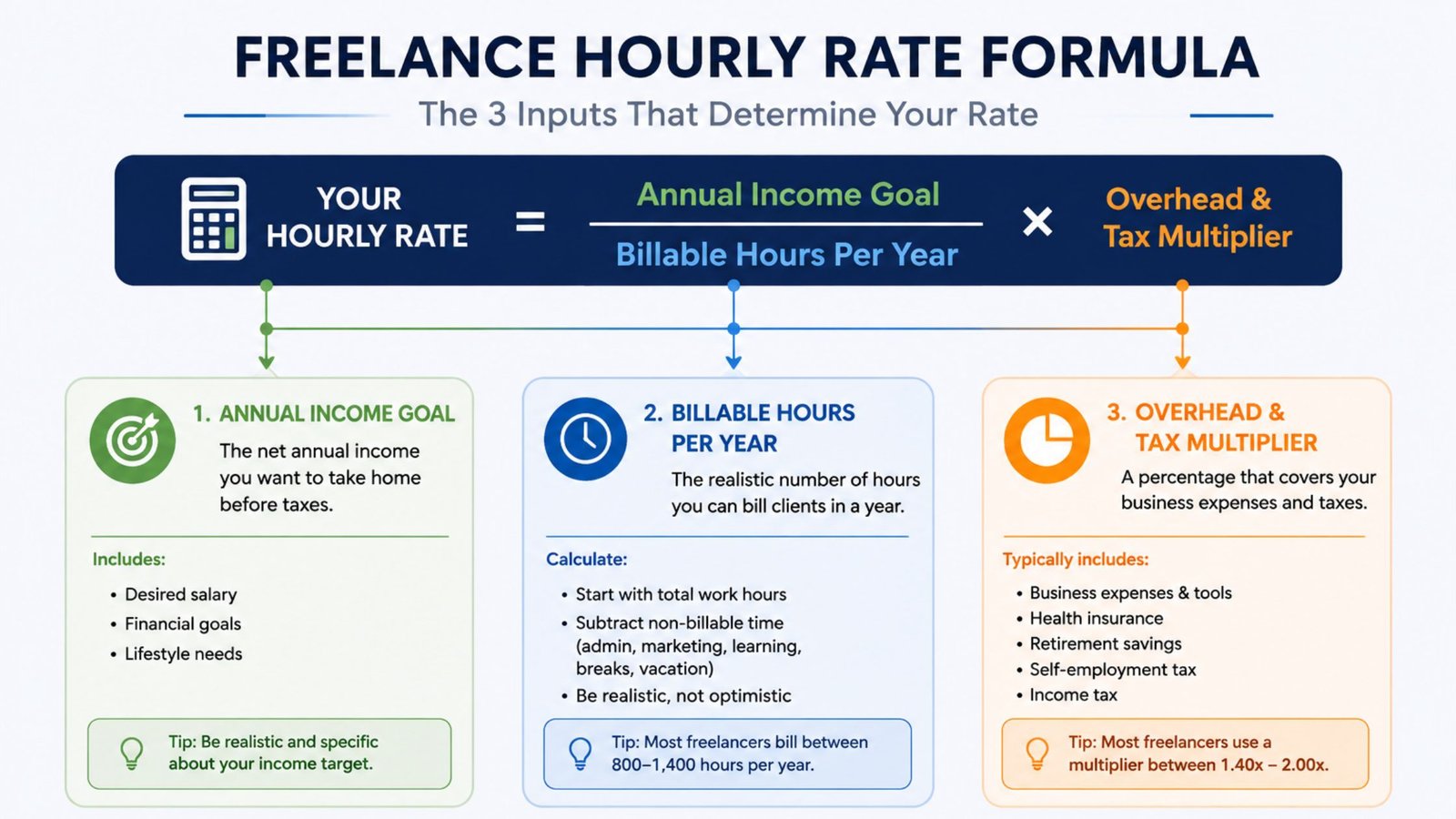
The Real Freelance Hourly Rate Formula
Most free calculators add your expenses as a flat dollar amount to your income goal, then divide by hours. nemin.io’s calculator works differently. It’s a better reflection of how freelancers actually think about pricing:
Day Rate = Annual Income Goal ÷ Billable Days Per Year Final Day Rate = Day Rate loaded with your stated overhead % and tax % Hourly Rate = Final Day Rate ÷ Billable Hours Per Day
Instead of guessing a dollar figure for expenses, you state overhead and tax as percentages on top of your day rate. That’s easier to keep accurate over time, since percentages don’t need updating every time a subscription price changes. It also matches how most freelancers actually think about costs, as a share of income rather than a fixed dollar bucket. The next three sections walk through each input before putting them together.
Step 1: Set Your Desired Annual Income
This is what you want to take home after the business pays for itself, not your gross revenue target. Start with a real number: what would make this work worth doing full-time. If you’re replacing a $70,000 salary, that’s your starting point, not the number after tax.
Don’t skip ahead to “market rate” yet. Market rate matters later, as a sanity check. But your own income goal is what the formula actually needs first.
Step 2: Set Your Overhead and Tax Percentages
This is the step most calculators get wrong by turning it into a long list of dollar line items to guess at. nemin.io’s approach loads overhead and tax as percentages on top of your day rate instead, which is faster to set and easier to keep current.
Tax percentage. According to the IRS, the self-employment tax rate is 15.3%, split between 12.4% for Social Security and 2.9% for Medicare, applied to 92.35% of net self-employment earnings. Add your expected federal and state income tax bracket on top of that. Most freelancers land somewhere between 25% and 35% as a total tax percentage, though this varies by state and income level.
Overhead percentage. This covers everything that keeps the business running: software and subscriptions, health insurance premiums, retirement contributions, liability insurance, professional memberships and a buffer for unpaid pitch and proposal time. For most solo freelancers, this lands somewhere between 10% and 20% of the day rate, higher if health insurance is fully self-funded.
A freelancer who sets these percentages too low or skips one entirely ends up with a rate that looks correct on the calculator screen and still falls short once real bills arrive.
Step 3: Count Your Realistic Billable Days (Not 260)
A working year has roughly 260 weekdays. Freelancers never bill anywhere close to that number. This is the step that trips people up the most.
Start by subtracting time off: vacation, sick days and holidays typically remove 15 to 25 days a year. What’s left still isn’t all billable, since admin, invoicing, proposals and slow stretches between projects eat into working days that never get invoiced. Most freelancers end up with somewhere between 130 and 160 realistic billable days a year, not the 260 a full weekday calendar suggests.
Billable hours per day matters too, for the final step of the formula. Few freelancers bill a full 8-hour day against a client; 5 to 6 billable hours out of a working day is a more realistic planning number once meetings, breaks and context-switching are factored in.
Worked Example: Plugging Real Numbers Into the Formula
Here’s how the inputs come together for a mid-level freelance copywriter aiming for a $70,000 income goal.
| Input | Amount |
|---|---|
| Annual income goal | $70,000 |
| Billable days per year | 150 |
| Base day rate | $466.67 |
| Overhead percentage | 15% |
| Tax percentage | 25% |
| Final day rate (loaded) | $653.33 |
| Billable hours per day | 6 |
| Calculated hourly rate | $108.89/hr |
The math: $70,000 ÷ 150 days = $466.67 base day rate. Load that with 40% combined overhead and tax (15% + 25%) to get $653.33. Divide by 6 billable hours a day. The final rate lands at $108.89 an hour. Compare that to the naive version most freelancers try first, dividing $70,000 straight by 2,080 hours (a full 40-hour, 52-week year), which spits out $33.65 an hour. That’s less than a third of the real number. It’s exactly the kind of gap that keeps freelancers underpaid without them ever seeing why.
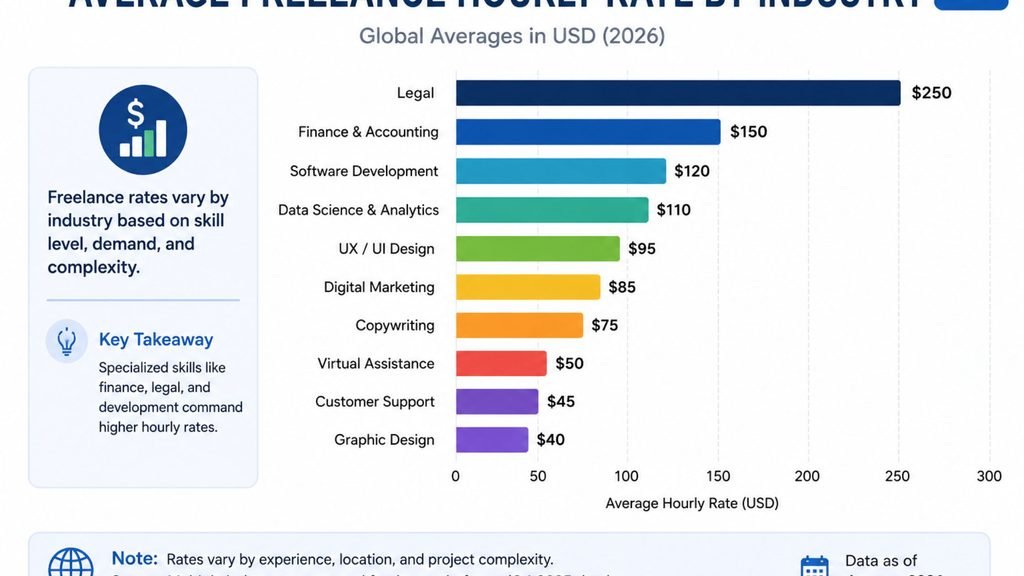
Where Your Rate Should Land: Industry Benchmarks
Once you have a calculated rate, check it against what your field typically charges. If your number lands well below the range for your experience level, that’s a signal to revisit your inputs, not necessarily to accept a below-market rate.
| Field | Entry Level (0-2 yrs) | Mid Level (3-6 yrs) | Senior (7+ yrs) |
|---|---|---|---|
| Web development | $40-65/hr | $75-110/hr | $120-200+/hr |
| Content writing | $20-40/hr | $45-75/hr | $80-130/hr |
| Graphic design | $25-45/hr | $55-85/hr | $90-150/hr |
| SEO / marketing consulting | $35-55/hr | $65-100/hr | $110-175/hr |
| Virtual assistance | $15-25/hr | $30-50/hr | $55-80/hr |
Rates vary by location, niche and client type, so treat this as a directional check, not a ceiling.
The Number Doesn’t Stop at Your Rate
Here’s the part most rate calculators skip entirely. A calculated hourly rate is a starting point, not a finished decision. Before locking it in, it’s worth stress-testing that number two more ways.
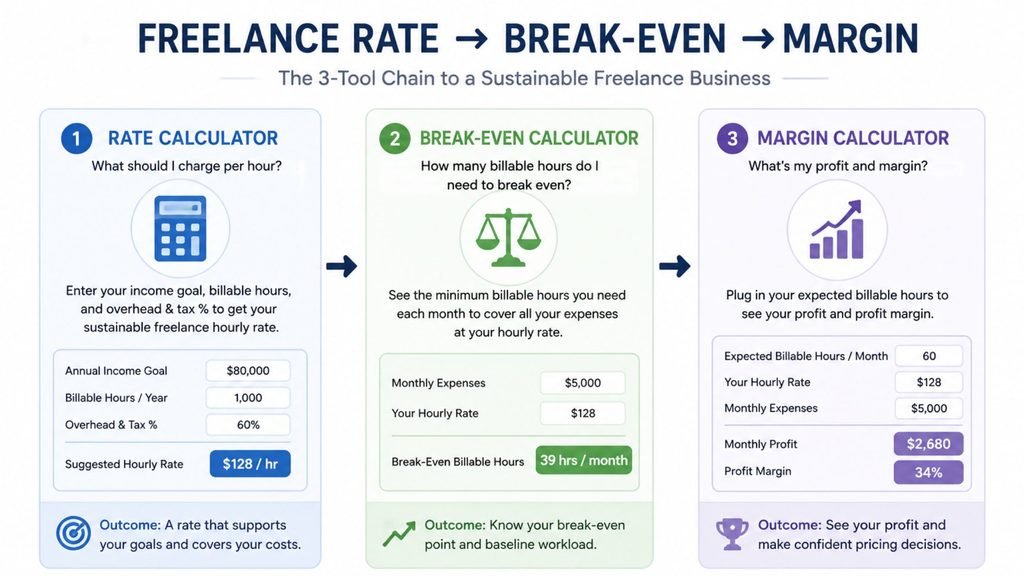
First, run these numbers through the calculator to confirm the math, then check that number against your break-even point. Break-even tells you the minimum billable hours you need each month just to cover expenses, before a single dollar counts as profit. If your calculated rate technically works on paper but your break-even point requires more billable hours than you realistically have, the rate isn’t actually sustainable yet.
Second, if any part of the work involves a retainer, a package price or a project quote rather than pure hourly billing, run the numbers through nemin.io’s margin calculator as well. An hourly rate and a healthy margin on a fixed-price project aren’t automatically the same thing. A freelancer who only checks one of the two can end up profitable on paper while losing money on the actual work.
This three-step check, rate, then break-even, then margin, catches pricing mistakes a single hourly-rate number never will.
Common Mistakes That Quietly Undercharge Freelancers
- Using 260 billable days instead of a realistic number. This alone accounts for the biggest pricing gap most freelancers ever make.
- Setting the tax percentage too low. A rate that looks fine before tax often isn’t after it, especially once state income tax is added to the 15.3% self-employment tax base.
- Treating pitch and proposal time as free. Unpaid client-acquisition hours still need to be covered by the overhead percentage, not ignored.
- Never revisiting the percentages after the first calculation. Expenses, experience and inflation all move. Overhead and tax percentages set two years ago rarely still fit.
- Checking only the hourly number, never the break-even or margin behind it. A rate can look correct in isolation and still fail once real billable days and real overhead are applied over a full month.
When and How to Raise Your Rate
Review the calculation at least once a year or any time expenses, income goals, or billable capacity shift meaningfully. A rate increase makes sense when you’re consistently fully booked, when your experience has moved you into a higher benchmark bracket or when expenses have climbed since the last calculation. Raising a rate for new clients only, while honoring existing agreements until their natural end point, is usually the smoothest way to make the change.
FAQs
How do I calculate my freelance hourly rate?
Divide your annual income goal by your realistic billable days per year, not the 260 weekdays on a calendar, to get a base day rate. Load that with your overhead and tax percentages, then divide by your realistic billable hours per day to get an hourly figure. Most freelancers land between 130 and 160 realistic billable days a year once time off and non-billable work are accounted for.
What is a good freelance hourly rate?
It depends entirely on field, experience and location, so there’s no single number. Entry-level rates commonly start in the $20-45/hr range depending on the discipline, while senior specialists in higher-demand fields often charge $100/hr or more. Compare your calculated rate to your field’s benchmark range rather than a flat industry average.
How many billable hours can a freelancer realistically work per week?
Most freelancers can bill somewhere between 20 and 30 hours out of a 40-hour work week. The remaining time goes to admin, invoicing, proposals and client communication, none of which is billable but all of which still takes real time.
Do freelancers pay more tax than employees?
Freelancers pay self-employment tax on top of regular income tax, currently 15.3% on 92.35% of net earnings, covering both the employee and employer portions of Social Security and Medicare that a traditional job would split with an employer. This is why a freelance rate has to be meaningfully higher than an equivalent salaried wage to net the same take-home pay.
How often should I review my freelance rate?
At least once a year or any time your expenses, experience level or billable capacity change significantly. A rate that made sense two years ago rarely still reflects current costs or current market demand.
Is my freelance rate too low if it’s below the industry average?
Not automatically, since averages vary widely by field, location and experience. But if your calculated rate sits well below the entry-level range for your specific discipline, it’s worth rechecking your billable-hours assumption first, since that’s the input most freelancers get wrong.