

Social Media Management Pricing: What to Charge and How to Build Your Packages
Most freelancers charge between $500 and $3,000 a month for social media management. Boutique agencies charge $2,000 to $8,000 and full service agencies start around $8,000. Those are the ranges published in 2026 pricing guides and they are a fair place to start. They are also a poor place to stop.
A range tells you what other people charge. It does not tell you whether your own price covers the work you are about to take on. Two providers can both quote $1,500 a month and one of them is delivering twelve posts while the other is delivering thirty plus daily replies. Only one of those quotes is a good deal for the person who wrote it.
This guide gives you the market ranges first so you know where you stand. Then it does the more useful thing. It builds three packages from the workload behind each one so every price has a reason you can explain to a client.
What a social media management price actually covers
When a client asks for a monthly price they are usually asking for several different jobs bundled under one heading. Separating them is the first step to pricing any of them well.
- Content creation. Writing captions and designing graphics or editing short video. This is the most visible work and often the biggest block of hours.
- Publishing and scheduling. Loading posts and timing them for each platform. Small per post but it adds up across platforms.
- Community management. Replying to comments and answering direct messages. This is the hidden cost because it is never finished.
- Strategy and planning. Content pillars and a monthly calendar plus competitor checks.
- Reporting. A monthly summary at the low end and weekly numbers with a call at the high end.
A price that only counts the first two items is a price that quietly gives the other three away. Keep this list in mind through the rest of the guide because it explains why the cheapest quotes are rarely the cheapest to deliver.
Social media management pricing by provider type
The table below pulls together published 2026 ranges. Treat every figure as a band rather than a target. The numbers come from pricing guides that report them as industry averages and none comes from a single audited study.
| Provider type | Typical monthly price | Typical hourly rate | Source as reported |
|---|---|---|---|
| Beginner freelancer | $500 to $1,500 | $20 to $50 | SocialRails 2026 and MySocial citing SolidGigs 2026 |
| Experienced freelancer | $1,500 to $3,000 | $50 to $150 | SocialRails 2026 |
| Boutique agency | $2,000 to $8,000 | $75 to $300 | SocialRails 2026 and ALM Corp 2026 |
| Full service agency | $8,000 to $25,000 and up | $200 and up | SocialRails 2026 |
Business size shifts the same ranges from the buyer side. One 2026 guide puts small businesses at $1,000 to $3,000 a month for two or three platforms and mid-market companies at $3,000 to $7,500 (Digital Applied, April 2026). If your prospect is a small local business a quote far above $3,000 needs a clear reason.
The hourly column matters even if you never bill hourly. It shows you the rate your monthly price has to equal once you divide it by the hours you actually spend. If you have not worked out your own number yet start with work out what an hour of your time costs before reading further.
Three ways to quote the same work
The same workload can be priced in three different shapes. Each one hides a different risk.
Per post. You charge a fixed amount for every piece of content. One 2026 guide cites static posts at $75 to $150 and video posts at $200 to $500 (Ruul, 2026). This is easy to explain and easy to scale up or down. The risk is that community management and strategy fall outside the unit so they go unpaid unless you add them as separate lines.
Per platform. You charge a monthly amount for each channel you manage. Reported platform rates vary widely. Pinterest sits near $500 to $1,200 and Instagram near $750 to $1,500 while TikTok runs $1,500 to $3,000 (Ruul, 2026). The same source puts X at $200 to $400. This works because different platforms demand different effort. The risk is that a client assumes the second platform is cheap when it needs its own content format.
Flat package. You charge one monthly price for a defined bundle. This is the most common model for ongoing work and the one most searchers are looking for. The client gets a predictable bill. You get recurring revenue. The risk is scope creep because a flat price rewards the client for asking for more.
Most providers end up with a flat package built on top of per post and per platform math. That is the approach used in the rest of this guide.
Build the package from the workload

Here is one package priced from the ground up. The client wants three platforms with three posts a week on each.
- Content volume is 3 platforms times 3 posts times 4 weeks which equals 36 posts a month.
- At a blended $60 per post for copy and design plus scheduling that is $2,160. Set your own blended figure from how long a post takes you at your hourly cost.
- Community management at about 10 hours a month and $45 an hour adds $450.
- A monthly report with a short summary adds $250.
The total is $2,860. A fair quote for this scope is about $2,900 a month. That figure sits inside the $2,500 to $5,000 Growth band that ALM Corp reports for two to three platforms and 12 to 20 posts (ALM Corp, April 2026). Notice that the quote is not a guess pulled from a chart. Every line is something you can point to when a client asks why it costs what it costs.
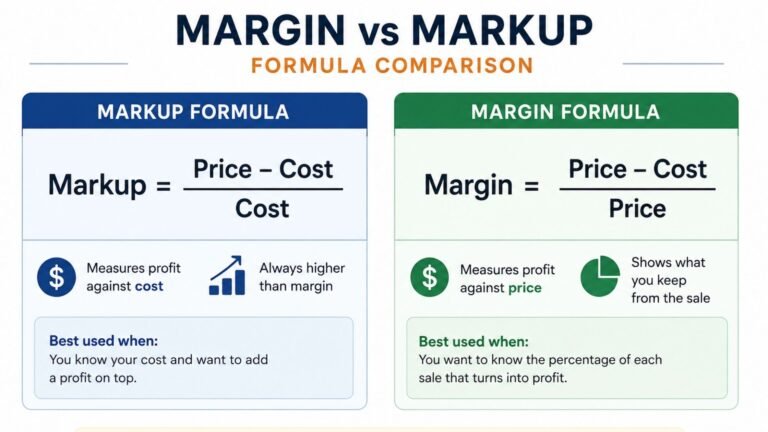
Check the margin before you send it. Your cost to deliver is the hours you spend times your loaded hourly cost and the quote only works if it leaves a profit after that. If the difference between the two numbers is confusing read margin and markup are different numbers first. The same logic scales up. A full retainer for a larger account follows the method in building a retainer from an hours budget.
A package ladder you can adapt

Searchers looking up packages and plans are the largest single group in this topic. A three tier ladder gives a prospect a clear choice and keeps you from negotiating from scratch every time.
| Tier | Platforms | Posts a month | What is included | Typical monthly price |
|---|---|---|---|---|
| Starter | 1 to 2 | 8 to 12 | Content calendar and copy and design and scheduling. Monthly report and one review call | $1,500 to $2,500 |
| Growth | 2 to 3 | 12 to 20 | Starter plus strategy and content pillars and community management. Monthly report and strategy call | $2,500 to $5,000 |
| Authority | 3 to 4 | 16 to 30 | Growth plus video editing and competitor review and deeper reporting | $5,000 to $8,500 |
The tier boundaries and scopes follow the package structure published by ALM Corp in April 2026. Freelancer prices usually sit toward the lower end of each band and agencies toward the upper end. One 2026 freelancer guide splits the same idea differently with basic at $750 to $1,500 for one or two platforms and standard at $1,500 to $3,000 for two or three (MySocial citing SolidGigs, 2026).
Three rules keep a ladder honest. Name each tier by its scope and not by adjectives. Put the post count in writing. Make Growth the tier you actually want to sell by pricing Starter so that most clients see Growth as the sensible next step.
Where a simple per post formula falls short
Many providers price social media with one formula and it is worth knowing how far that formula goes. The Social Media Pricing Calculator on this site works that way. It multiplies platforms by posts per week by four weeks by a flat $25 per post and then adds a reporting amount of $200 for basic $500 for standard or $1,200 for advanced reporting.
With the default inputs of two platforms and four posts a week that gives 2 times 4 times 4 times $25 which is $800. Add $500 for standard reporting and the result is $1,300 a month. You can run your own platform and post counts through the calculator to see how the number moves.
Compare that with the Growth example above. The same calculator inputs for three platforms and three posts a week give $900 plus $500 which is $1,400. The workload build came to $2,860. The gap is not a flaw in either number. The calculator prices the content and the reporting level. It does not know about community management or strategy time or the higher blended cost of a post that needs real design. Use the result as a baseline and then add the work the formula cannot see.
Add-ons that protect the margin
A package should not need a renegotiation every time the client asks for something extra. Price the common extras in advance. Published 2026 ranges include an extra platform at $300 to $1,500 a month and additional short form videos at $150 to $750 each. A strategy workshop is cited at $750 to $3,000 and account setup or an overhaul at $500 to $2,500 (ALM Corp, April 2026).
Setup fees deserve special mention. The first month of any account takes longer because you are learning the brand and auditing existing channels and building the first calendar. A one time setup fee pays for that month so the recurring price stays honest afterward.
Paid social is a separate decision. Management fees cover planning and publishing and community work while ad budget is paid to the platform. If you also run the ads quote a separate management fee for it. The related cost per click and cost per thousand impressions figures are covered in the guides on what a good cost per click looks like.
Write the scope down before the first invoice
A package price only holds if the scope behind it is written into the proposal. Most social media pricing disputes start with a sentence nobody wrote down such as “and we will reply to comments” or “a few stories each week”. List what is included in plain numbers. State how many posts and which platforms and how many rounds of edits apply to each. Say how many days a reply to a client message normally takes and which channel carries it.
Then say what is not included. Paid ad management and influencer outreach and photo or video shoots are the usual items that grow quietly if left unnamed. Add one line explaining how an out of scope request is handled. A common version is a quote for the extra work within two working days with approval needed before anything starts.
Clients rarely object to a clear boundary. They object to a surprise. A written scope also gives you a neutral reference point on the day you need to raise the price because you can show exactly how the work has grown since the first month.
When to raise your price
Prices drift out of date quietly. Three signals tell you it is time to move.
The first is capacity. If you are full and still get new enquiries your price is too low. The second is scope. If a client’s account has grown from two platforms to four without a price change you are being paid for the old job. The third is time. If your hours per client are creeping up while the fee stays flat your effective hourly rate is shrinking each month.
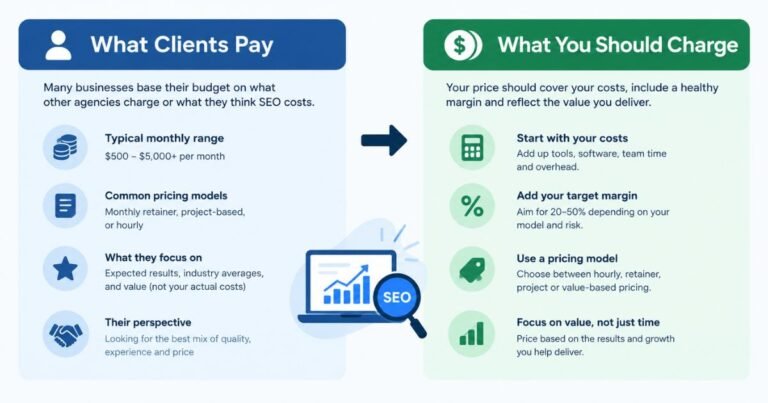
Give existing clients notice and tie the increase to a defined change in scope or in results. For a comparison of how other service providers handle the same decision see pricing SEO work.
Frequently asked questions
How much should a beginner charge for social media management?
Published 2026 guides put beginners at roughly $500 to $1,500 a month for one or two platforms and $20 to $50 an hour. Price from the hours the work really takes and move up the ladder as results and testimonials build.
Should I charge hourly or a monthly package?
A monthly package suits ongoing work because the client gets a predictable bill and you are paid for the outcome. Use hourly pricing for audits and one off projects where the scope is unclear.
Is ad spend included in a social media management price?
No. Management fees cover planning and publishing and community work. Paid ad budget is billed separately and is paid to the platform. Many providers add a paid social management fee on top.
How many posts should a monthly package include?
Starter packages commonly include 8 to 12 posts a month across one or two platforms. Growth packages run 12 to 20 posts and premium packages 16 to 30 assets with video. Define the number in writing.
Price one package this week
Pick one current client and list the five jobs from the start of this guide. Next to each one write the hours it took last month. Multiply by your hourly cost and compare the total with what the client pays. If the fee is lower or close the package is underpriced and you now have the numbers to fix it at the next renewal.
One Comment