
How Much Should You Charge for SEO Services? (2026 Framework)
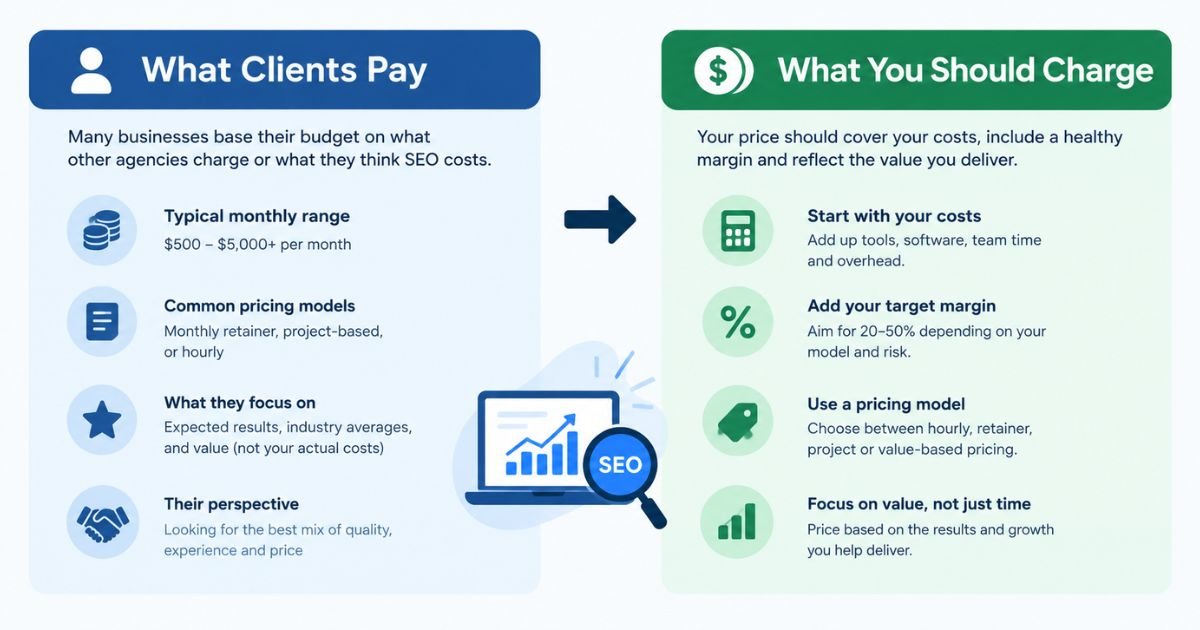
Ask ten SEO freelancers what they charge. You will get ten different numbers. Most of them picked that number the same way: they looked at two or three competitor websites, guessed at a figure that felt roughly in the middle, then hoped nobody asked them to justify it. Some of those freelancers are running a healthy business. Many are not. A number that feels competitive and a number that actually covers your costs are not the same thing. Nobody tells you which one you picked until the bank account starts telling you first.
The agencies that struggle most are not the ones losing pitches. They are the ones winning pitches at a price that was never going to work, then discovering the gap only after months of delivering work that costs more than it earns. Survey data backs this up directly: agencies that quote clients without first calculating their true delivery cost underprice their work by 20 to 40 percent on average. That is not a rounding error. That is the difference between a business with a real future and one running on fumes while it looks busy.
This guide skips the part where you copy someone else’s rate card. Instead it starts with a formula you can run for your own business in about ten minutes, one that tells you the lowest number you can charge before you lose money on every project. From there it walks through how to layer market positioning, package structure and experience level on top of that floor so the final number reflects your actual value rather than a guess borrowed from a stranger’s website.
Why most SEO providers price themselves wrong
The underpricing problem rarely comes from a lack of ambition. It comes from skipping a step. Most freelancers and small agency owners can tell you roughly what they want to earn in a year. Far fewer can tell you their base hourly cost: the number that includes salaries, software, overhead and every hour that goes unbilled to sales calls, admin work and client management.
Without that number, every quote is a guess dressed up as a decision. The gap between specialized and generalist providers shows exactly what is at stake. Agencies that focus tightly on SEO report profit margins between 25 and 40 percent, while generalist digital marketing shops offering SEO as one service among many average only 15 to 20 percent. The difference is not that specialists are smarter. It is that a tighter focus makes it far easier to know your real delivery cost per client, which makes it far easier to price above it with confidence.
Labor is the largest cost driver in this equation by a wide margin. Junior-level work typically runs $50 to $100 an hour in direct cost, while senior strategist time runs $175 to $500 or more depending on market and specialization. If you have never mapped your own team’s cost per hour against what you charge per hour, you are not pricing. You are hoping.
Step 1: Find your price floor with a cost-plus formula
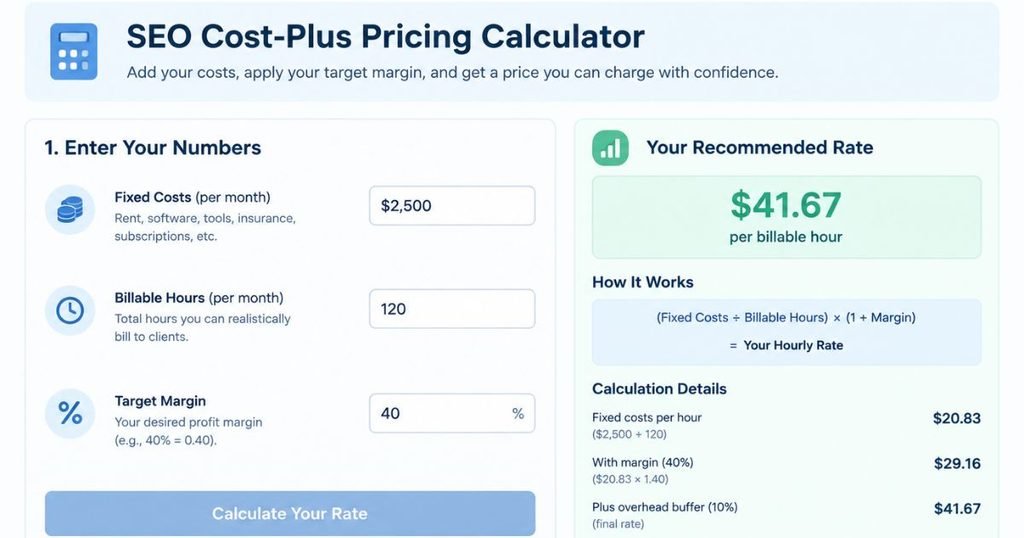
Before you think about what the market will bear, calculate what your business requires. The formula is simple. Most freelancers or small teams can run it in under ten minutes once they have gathered the inputs.
Base hourly cost = (Total monthly salaries or your own target pay, plus total monthly overhead) divided by total monthly billable hours
Total monthly overhead includes software subscriptions, any contractor or white-label costs, insurance and a reasonable share of general business expenses like a home office or coworking membership. Total monthly billable hours should reflect reality rather than an idealized 40-hour week, since sales calls, admin, invoicing and unpaid onboarding time all eat into what you can actually bill.
Once you have that base hourly cost, add your target profit margin on top of it as a fixed line in the calculation, the same way a retailer marks up wholesale cost rather than hoping profit shows up on its own at the end of the year. A freelancer working solo can use nemin.io’s Freelancer Hourly Rate Calculator to run this exact math against their own income goal, billable days and overhead percentage in a couple of minutes rather than a spreadsheet.
Every project, retainer or hourly quote you send should sit above this number. If a prospective client’s budget cannot clear your floor, that is useful information delivered early, well before you have spent unpaid hours discovering it the hard way.
Worked example: two different businesses, two different floors
The table below shows how differently this plays out for a solo freelancer working from home compared with a three-person agency running an office and a contractor.
| Input | Solo freelancer | Three-person agency |
| Target annual pay or salaries | $70,000 | $210,000 combined |
| Monthly overhead (software, insurance, workspace) | $350 | $4,200 |
| Billable hours per month | 100 | 320 |
| Base hourly cost | $86 | $67 |
| Target margin | 30 percent | 25 percent |
| Minimum hourly rate to charge | $112 | $84 |
| Minimum monthly retainer at 15 hrs/mo client | $1,680 | $1,260 |
Two things stand out here. First, the agency’s base hourly cost is actually lower than the freelancer’s, purely because overhead and salary get spread across more billable hours. This is one reason small agencies can sometimes underprice solo freelancers on a like-for-like basis without realizing it. Second, neither number resembles a rate picked by glancing at three competitor websites. Both come directly from real costs, so both providers can defend the number with confidence instead of hoping the client does not ask.
Step 2: Choose the pricing model that fits the relationship
With a floor established, the next decision is structure. Four models dominate the SEO services market. Each fits a different stage of the client relationship.
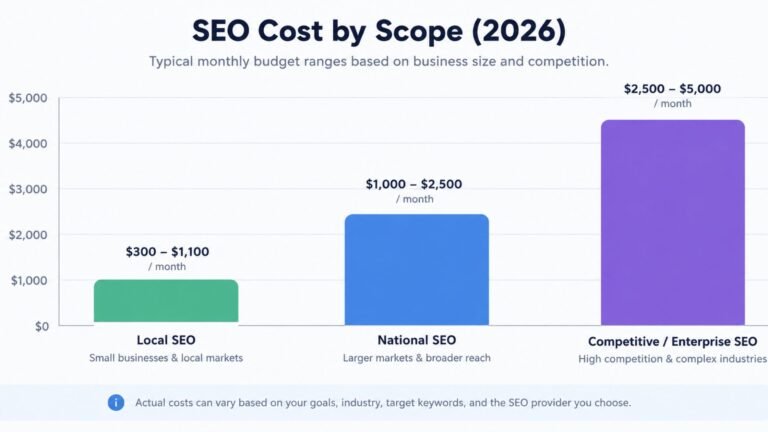
Monthly retainer is the most common model, used by roughly three out of four agencies. It makes sense for SEO specifically because the work is ongoing rather than a one-time deliverable. Retainer ranges vary enormously by client size: small local businesses often pay under $1,500 a month, growing small and mid-size businesses land between $1,500 and $5,000, while national or enterprise brands regularly pay $5,000 to $15,000 or more. Run your own numbers through nemin.io’s Agency Retainer Calculator, which factors in hours needed, blended hourly rate and management overhead rather than just picking a number from a chart like this one. For the full method of building a retainer from an hours budget, see how to set an agency retainer fee. For context on what clients on the other side of that conversation are already budgeting, see our breakdown of how much SEO typically costs in 2026.
Project-based pricing works well for defined, bounded work like a technical audit, a site migration or an initial SEO setup before an ongoing retainer begins. It caps risk on both sides while a new relationship is still building trust. That is why many agencies use it as the entry point before moving a client to a retainer once results start showing.
Hourly billing remains common globally, with rates ranging from roughly $75 to $150 an hour on average and $100 to $300 or more for specialized or highly experienced providers in higher-cost markets. It offers the most transparency but the least predictability for both sides. Clients sometimes resist it too, since SEO’s ongoing nature makes an open-ended hourly relationship feel harder to budget for than a flat retainer.
Performance-based or pay-per-result pricing ties fees to outcomes like ranking position, traffic or leads. It sounds attractive to clients but carries real risk for the provider, since SEO results lag the actual work by months and depend heavily on factors the provider does not control, like a client’s site speed, existing domain authority or a competitor’s own campaign. Most established agencies avoid it as a primary model and reserve it, if at all, for a narrow slice of engagements with especially clean attribution.
Whichever model you choose, nemin.io’s Client Quote Builder can combine your hours, any materials or tool costs and your target margin into a single defensible number ready to send rather than a figure assembled by memory during a client call.
Step 3: Package your pricing so clients can choose without you negotiating every deal
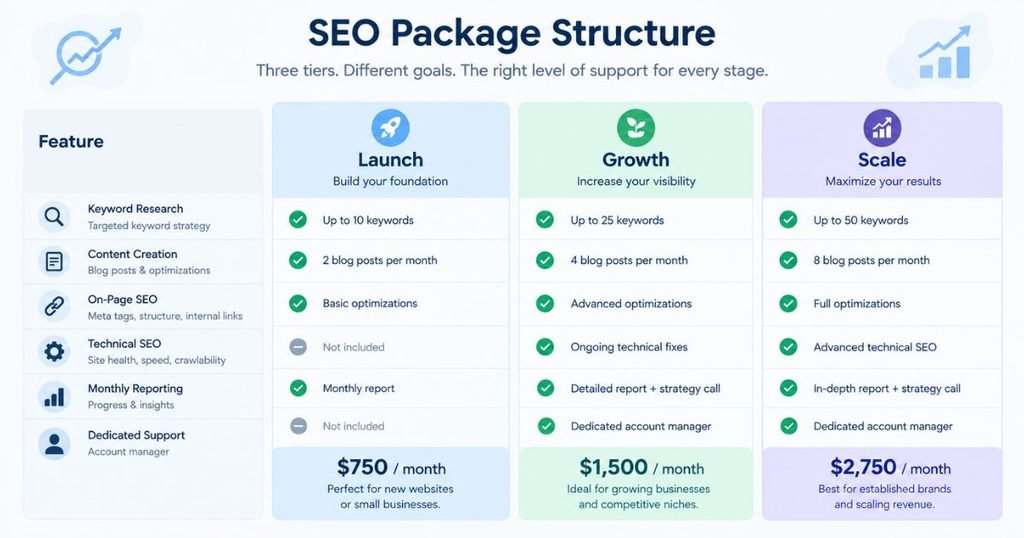
A single flat price forces every prospective client into a yes-or-no decision. A surprising number of them will simply walk away rather than negotiate. A tiered package structure, commonly labeled something like Launch, Growth and Scale, solves this by giving a client an obvious middle option while still capturing smaller and larger budgets at the edges.
Build the middle tier first and price it to be genuinely profitable on its own, since it is the option most clients actually pick. The lower tier exists mainly to capture budget-constrained prospects who would otherwise leave entirely. It should still clear your cost floor even if the margin is thinner. The top tier exists to anchor the middle tier as reasonable by comparison and to capture the clients willing to pay more for faster timelines or a broader scope.
This structure also protects you from the most common pricing trap in SEO specifically: scope creep on an underpriced retainer. When the deliverables at each tier are written down clearly, a client asking for more work has an obvious next step: moving up a tier rather than an awkward renegotiation of a number nobody wrote down in the first place.
How experience and specialization change what you can charge
Two providers with identical cost structures can justify very different prices once experience and specialization enter the picture. A newer consultant with a lower cost base can reasonably charge less and still hit a healthy margin, since their overhead and target pay are both lower too. But the floor calculation should never disappear just because someone is starting out. A beginner skipping the cost-plus formula and pricing purely on what feels competitive is exactly the pattern behind that 20 to 40 percent underpricing gap.
Specialization moves the ceiling more than experience alone does. An agency that only does SEO for a specific niche like local service businesses or ecommerce can typically charge a premium over a generalist digital marketing shop offering SEO as one line item among many. The client is paying for depth rather than breadth. Depth is harder to shop around for. This is also why specialized SEO agencies report the highest margins in the profitability data cited earlier: focus makes both delivery and pricing easier to get right.
When and how to raise your prices
Prices should move at least once a year for existing clients, tied to inflation, added scope or simply the fact that your delivery cost has changed since the relationship started. New clients should always be quoted your current rate rather than a legacy number carried over out of habit.
The clearest signal that your price is too low is a fully booked calendar. If you are turning away work at your current rate, the market has already told you the price could be higher. The only remaining question is how to communicate the increase to existing clients without losing the ones worth keeping. A short notice period, typically 30 to 60 days, paired with a clear explanation tied to added value or scope, tends to retain the clients who were actually profitable to keep in the first place.
Frequently asked questions
Should you charge for SEO by the hour, by project or as a retainer?
Most agencies settle on a monthly retainer once the relationship is proven. A project-based engagement is usually the safer starting point with a new client since it caps risk on both sides while you are still learning how the work actually goes together.
What is a healthy profit margin for an SEO agency in 2026?
Survey data puts a healthy net margin between 15 and 25 percent for generalist agencies, with specialized SEO-only shops reaching 25 to 40 percent. A margin well under 15 percent usually means either the pricing or the delivery cost needs attention.
How do you know if you are underpricing your SEO services?
If you have never calculated your own base hourly cost, you are very likely underpricing. Industry data shows agencies that quote without knowing their true delivery cost underprice by 20 to 40 percent on average compared to what the work actually costs to deliver.
Should a beginner charge less than an experienced SEO consultant?
Yes. The floor should still cover real costs though. A beginner’s lower rate should come from a genuinely lower cost base and leaner overhead rather than from skipping the cost-plus calculation altogether.
Is performance-based SEO pricing a good idea?
It works for a narrow slice of engagements with clean attribution and a client willing to share the upside. Most agencies avoid it as a primary model since SEO results lag the work by months and depend on factors outside the provider’s direct control.
How often should you raise your SEO prices?
Once a year at minimum for existing clients. For new clients, raise immediately the moment your calendar stays consistently full, since a full calendar is the clearest signal the market will bear a higher number than you are currently charging.
The bottom line
A defensible SEO price starts with your own numbers rather than a competitor’s rate card. Calculate your floor with the cost-plus formula, choose a pricing model that fits the relationship, package it so clients have an obvious middle choice, then revisit the number at least once a year. Everything after that floor is positioning. Positioning only works once the math underneath it is solid.

2 Comments