
Agency Retainer Fee: How to Price It (2026 Guide)
The agency retainer fee is the number everyone argues about on a proposal call. It is rarely the number that decides whether the retainer makes money. That number sits one level down in the hours budget behind the fee and most agencies set it once at signing then never look at it again.
That gap explains why two agencies can charge the same monthly retainer and end up with very different businesses. One of them knows what each month of work costs to deliver and checks it every month. The other can find out in month six that a client who looked profitable on paper has been using 60 hours of a 40 hour budget.
This guide covers both halves. First the market side: what agencies charge for common retainer types and what a marketing agency retainer usually includes. Then the part most pricing guides stop short of: how to build the fee from an hours budget and how to audit a live retainer so you catch a leak while it is still small.
What an agency retainer fee actually pays for
An agency retainer is a recurring monthly payment that reserves a defined amount of an agency’s time or output for one client. The client is not buying a finished project. They are buying continued access to a team and a steady stream of work against an agreed scope. That distinction sits at the heart of the agency retainer model and it shapes everything from how you price the work to how you report on it.
Retainers have taken over agency billing for reasons that have little to do with client preference. A compilation of agency research from SHNO reports that about 70 percent of digital marketing agencies use retainers (Promethean Research, 2025). The same compilation cites Focus Digital’s 2025 figures: retainer clients stay for an average of 56 months against 24 months for project clients and annual churn runs at 18 percent for retainer agencies against 42 percent for project based ones. Predictable monthly revenue is easier to staff against. Longer client lifespans also spread the cost of winning each client across more months.
The tradeoff is that a retainer turns a one time pricing decision into an open ended delivery commitment. A project that overruns eventually ends. A retainer that overruns repeats every month. That is why this guide puts as much weight on monitoring the retainer as on setting its price.
A client weighing a retainer against project pricing is really choosing between paying for an outcome once and paying for access continuously. Retainers fit continuous work such as content production, SEO, paid media management and ongoing support. Project pricing fits work with a finish line such as a site build or a rebrand.
What agencies charge per month by service
Monthly retainer ranges depend on the service, the size of the agency and the seniority of the people doing the work. The table pulls published benchmarks together so you can see where a quote sits. Treat every range as a band rather than a target.
| Service | Typical monthly retainer | Source as reported |
|---|---|---|
| Social media management | $500 to $1,500 basic; $2,000 to $10,000 and up full service | AgencyAnalytics, 2025 |
| SEO | $2,500 to $5,000 professional; $5,000 to $10,000 premium | AgencyAnalytics, 2025 |
| PPC management | $1,500 to $15,000 or 10 to 20 percent of ad spend | WebFX, 2026 |
| Content marketing | $1,000 to $9,500 and up | DesignRush, 2026 |
| Full service marketing, small and mid size business | $2,500 to $10,000 | BA3 Digital Marketing, 2025 |
| Digital PR | About $5,458 average | BuzzStream, 2025 |
Two cautions apply to any benchmark table. First the sources disagree. One compilation from Haus Advisors puts the directory listed hourly average for digital agencies at $82.66 and a self reported average at $137.94, a gap of roughly 67 percent between two samples of the same industry. Second paid media retainers rarely cover the whole bill. An ad agency retainer fee usually pays for campaign management while the media budget is paid on top. That is why a PPC quote of 10 to 20 percent of ad spend can look cheap or expensive depending on the budget underneath it.
Branding agency retainer rates and other creative retainers are harder to benchmark. The deliverables vary more from client to client than SEO or social media work does so published averages say little. For creative and brand work the hours budget in the next section is a more reliable guide than any market range.
Web design and development agencies often sell a smaller monthly retainer after launch to cover updates and support. The guide to how web design packages are structured shows how those tiers are usually built.
Build the fee from an hours budget
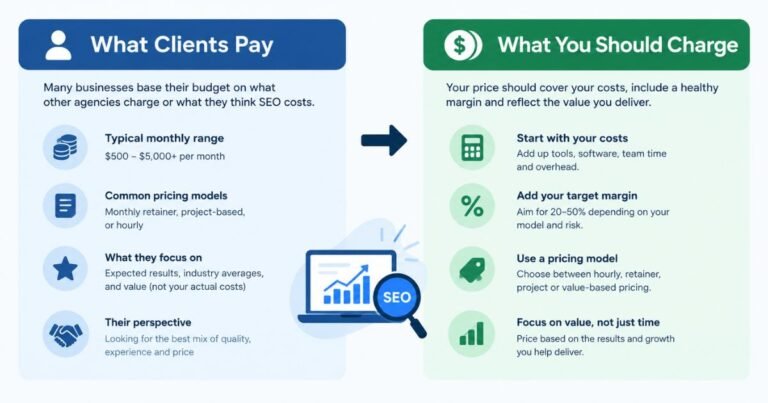
Market ranges show where other agencies landed. They do not show whether a given number covers your own costs. The reliable way to set an agency retainer fee is to start from the hours the scope needs and work upward.
The formula has four inputs. Delivery hours are the hours of production work the scope needs each month. Account management hours cover reporting, calls and client communication that never appear on a deliverable list. Loaded hourly cost is what one hour of a person costs you once payroll taxes and benefits or contractor markup are included. Tool costs are the software the scope depends on.
Retainer fee = ((delivery hours + account management hours) × loaded hourly cost + tool costs) divided by (1 minus target margin)
Take a content retainer with 40 delivery hours and 6 account management hours a month. At a loaded cost of $55 an hour that is $2,530 of labor. Add $150 of tools and the delivery cost is $2,680. A 50 percent target margin turns that into a fee of $5,360 because $2,680 divided by 0.5 is $5,360. Price the same scope at $4,000 and the margin falls to about 33 percent. The $1,360 difference looks small in a proposal. Over a year it is $16,320 of margin that never arrives.
Because loaded cost leaves out general overhead the target margin here is a gross margin. It has to pay for rent, shared software, sales time and profit. One retainer pricing guide from Taskip suggests aiming for a 50 to 65 percent gross margin for that reason. Net margins look much smaller. Predictable Profits data cited by SHNO puts net margins at 18 to 22 percent for seven figure agencies and 25 to 32 percent for eight figure ones.
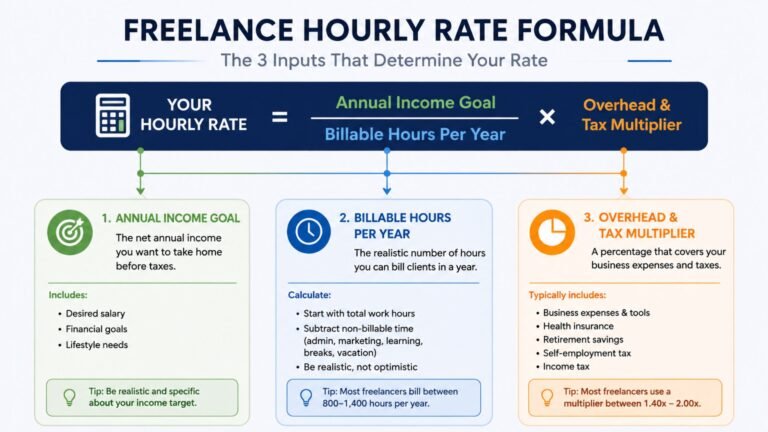
Solo operators who do not yet know their hourly figure can start from the freelancer hourly rate tool and adjust it for payroll costs. Once hours and costs are settled the retainer calculator on nemin.io turns scope, deliverables and team hours into a monthly figure you can compare against the formula above.
Apply the margin the right way round. Margin is measured against the price and markup against the cost so a 50 percent margin needs a 100 percent markup on cost. The article explaining why margin is not the same number as markup walks through the conversion.
Four ways to structure the fee
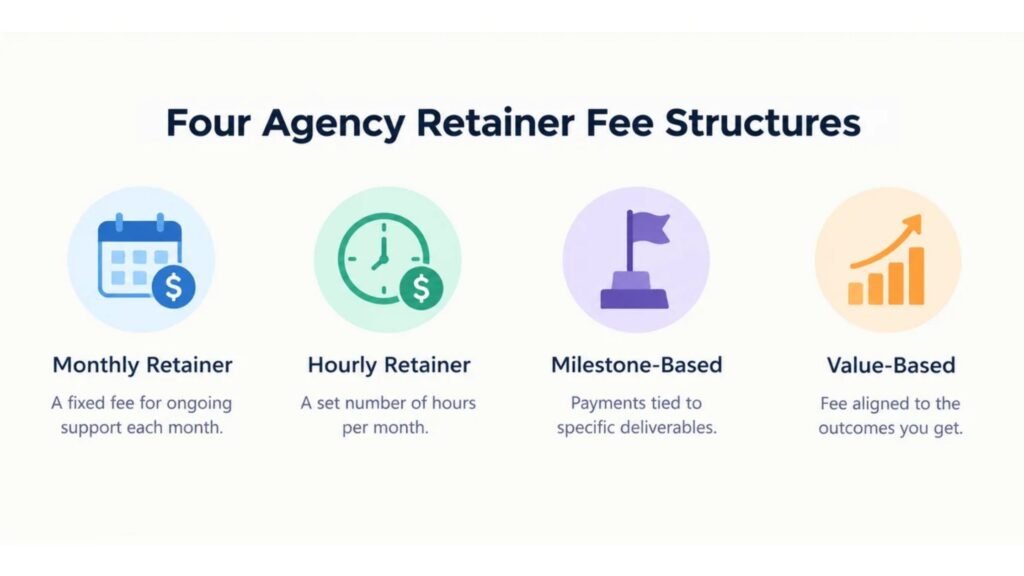
Once the number exists you still have to decide what the client sees on the invoice. For a content heavy example of the same decision see pricing social media work by package.
- Hours based. The client buys a fixed block of hours at a stated rate. It is the easiest model to explain and the easiest to audit. It also turns your time into a commodity so clients compare you on hourly rate alone.
- Deliverables based. The fee covers a defined output such as four articles and one report each month. It suits content and SEO work and spares you from counting hours in front of the client. It exposes you if the deliverables take longer than your budget assumed.
- Tiered packages. Three tiers at different scopes let the client choose without negotiating. Many agencies design the middle tier to carry the best margin since clients often settle on the middle option.
- Performance or value based. A base fee plus a bonus tied to agreed results. It can produce the highest margin but it needs clean attribution and a client willing to share upside. One compilation reports value based pricing adoption falling from 31 percent of agencies in 2024 to 18 percent in 2025.
Whichever model appears on the proposal the hours budget stays behind it. A deliverables based retainer still has a delivery cost and you still need to know what it is.
The month three audit most pricing guides skip
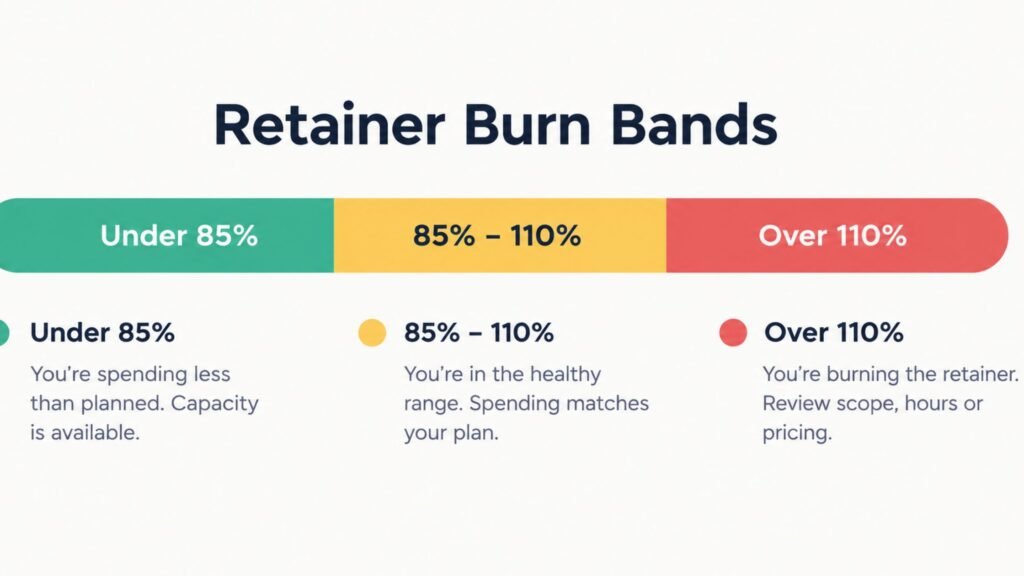
Setting the fee correctly is half the job. The other half is checking each month whether the retainer is delivering the margin you priced. Retainer burn is the share of budgeted hours that the work actually consumed. Hours logged divided by hours budgeted gives the burn rate.
A rule of thumb works well here although it is a working heuristic rather than a published benchmark. A burn rate between 85 and 110 percent is normal. Below 85 percent for two months suggests the client is under using the retainer and that often comes before a cancellation conversation. Above 110 percent for two months in a row means either scope creep or a budget that was too small from the start.
Scope creep deserves particular attention because agencies are generally poor at charging for it. A retainer pricing guide from Taskip cites the Ignition 2025 report finding that 78 percent of agencies rarely or sometimes charge for out of scope work. A retainer that quietly absorbs extras drifts below its target margin without any single moment that feels like a decision.
You do not need a dedicated retainer tool to see burn. Any time tracker that logs hours against a client code will do and a monthly spreadsheet comparing logged hours to budgeted hours is enough to start. What matters is that someone looks at the number every month.
If the audit shows a retainer is underpriced the fix is usually a sequence rather than a single conversation. Start by re-scoping: list what the client receives and cut or cap whatever is consuming the extra hours. Next add a stated overage rate so out of scope requests become visible change orders. If those two steps still leave the margin short raise the fee at renewal and give notice early. A sixty day notice gives the client time to adjust without feeling ambushed.
What the retainer agreement has to define
Nothing above holds up if the agreement is vague. Searches for an agency retainer agreement or an agency retainer proposal are common because every agency eventually needs one. A template will not set your fee but a handful of clauses decide whether the fee works in practice:
- A scope list that says what is included and what triggers an extra charge
- The monthly hours or deliverables the fee covers
- Whether unused hours roll over or expire
- The hourly rate for out of scope work
- The notice period for changing or ending the retainer
- The reporting cadence and who owns it
- The payment due date and late payment terms
Rollover is the clause that causes the most friction. Letting unused hours expire protects your capacity planning. Allowing a limited rollover feels fair to clients but it can stack up into a month where you owe far more work than the team can deliver. Decide the rule in advance and write it down.
How to show a client the retainer is worth paying
Clients ask whether an agency retainer is worth it for a simple reason: a recurring invoice with no visible end invites scrutiny. The question of the true ROI of an agency retainer is best answered before the client asks it.
Set a baseline metric and a target at the start of the engagement. For SEO that might be organic leads. For paid media it might be cost per lead. For content it might be qualified traffic. Report against that metric every month alongside the hours used. A client who sees the baseline and the target and the hours in one view rarely needs convincing that the fee is justified. A client who sees only a list of tasks completed will eventually ask what the money bought.
A marketing agency with a high retainer is not automatically overpriced. What matters is whether the fee is attached to a defined scope and a measurable target. A retainer is a poor fit when the need is one off. A rebrand or a site build belongs under project pricing and telling a prospect so plainly builds more trust than stretching a retainer to cover work with a finish line. For SEO specifically the guide to how SEO providers set their own prices goes deeper on retainers for that service.
Frequently asked questions
What is an agency retainer fee?
An agency retainer fee is a recurring monthly payment that reserves a defined amount of an agency’s time or output for one client. The client pays for continued access to the team and an agreed scope of work rather than for a single finished project.
How much do agencies charge for a monthly retainer?
It depends on the service. Published benchmarks put social media management at roughly $500 to $1,500 for a basic package and $2,000 to $10,000 or more for full service. Professional SEO retainers commonly run $2,500 to $5,000 and PPC management ranges from $1,500 to $15,000 or 10 to 20 percent of ad spend.
Should a new client start on a retainer or a project?
A project is often the safer start when the relationship is unproven because it has a clear end and a fixed scope. Once the work has an obvious next phase many agencies convert the client to a retainer.
What should I do if my retainer is underpriced?
Work through three steps in order. Re-scope the deliverables so the extra hours stop being absorbed. Add an overage rate so out of scope requests become visible change orders. If the margin is still short raise the fee at renewal and give notice early.
Do unused retainer hours roll over?
That depends entirely on the agreement. Some retainers let unused hours expire each month and others allow a limited rollover. Decide the rule before the retainer starts and write it into the agreement.
Audit one retainer this week
Pick your largest retainer and divide the hours logged last month by the hours you budgeted at signing. That single number tells you whether the fee you negotiated is the fee you are actually earning. If it falls outside the 85 to 110 percent band start with the re-scope step. Then use the formula above to price the next proposal from an hours budget instead of from a competitor’s rate card.

2 Comments