
Google Ads Cost Per Click: What’s a Good CPC in 2026?
You look at your Google Ads account and see a cost per click of $4.50. Is that good? Bad? Average? Without context, that number means nothing. Most advertisers never get the context because it depends entirely on what industry they are in. Before you judge your own numbers, run them through the Google Ads CPC Calculator to see how your google ads cost per click compares to businesses like yours, not to a generic average that may not apply to you at all.
This guide breaks down what is a good cpc for google ads by industry, what actually drives your CPC up or down, plus how to use that number to build a realistic monthly budget instead of treating it as a mystery figure Google hands you.
What Counts as a Good CPC Depends Entirely on Industry
There is no universal good cpc for google ads. Independent industry reports consistently show the cross-industry average landing somewhere between $3.00 and $5.50. That overall average hides enormous variation underneath it though:
| Industry | Typical CPC Range |
|---|---|
| Arts and entertainment | $0.60 to $1.65 |
| Retail and e-commerce | $1.15 to $4.00 |
| Travel and hospitality | $1.60 to $2.15 |
| Real estate | $2.75 to $3.25 |
| Finance and insurance | $3.00 to $6.25 |
| B2B and software | $3.30 to $4.00 |
| Business services | $4.90 to $6.00 |
| Home improvement | $5.00 to $8.35 |
| Dentists and dental services | $5.60 to $8.00 |
| Attorneys and legal services | $6.00 to $10.00 |
A $2.00 average cpc google ads figure is unremarkable for a travel business and would be a fantastic result for a personal injury lawyer. The reverse is also true. A $6.00 cpc would be alarming for a retail store and completely normal for a dental practice. Always compare your google ads cost per click against your own industry, never against the cross-industry average alone.
What Actually Drives Your CPC Up or Down
CPC is not a fixed price Google charges. It comes out of a real-time auction. Several factors determine what you end up paying:
- Competition for the keyword. More advertisers bidding on the same search term pushes the price up, which is why legal and insurance keywords cost so much more than arts and entertainment ones.
- Quality Score. Google rewards ads and landing pages that are more relevant to the search with a lower effective cost per click, meaning two advertisers bidding the same maximum can end up paying very different actual prices.
- Ad position and match type. Broader match types and higher-competition positions tend to cost more per click than tightly targeted, lower-position placements.
- Time of year and time of day. Retail CPCs spike around major shopping periods. Many service businesses also see costs shift by day of week as competitor budgets ebb and flow.
- Geographic targeting. A keyword targeted at a major metro area typically costs more per click than the same keyword targeted at a smaller market with fewer competing businesses.
Is a High CPC Good or Bad?
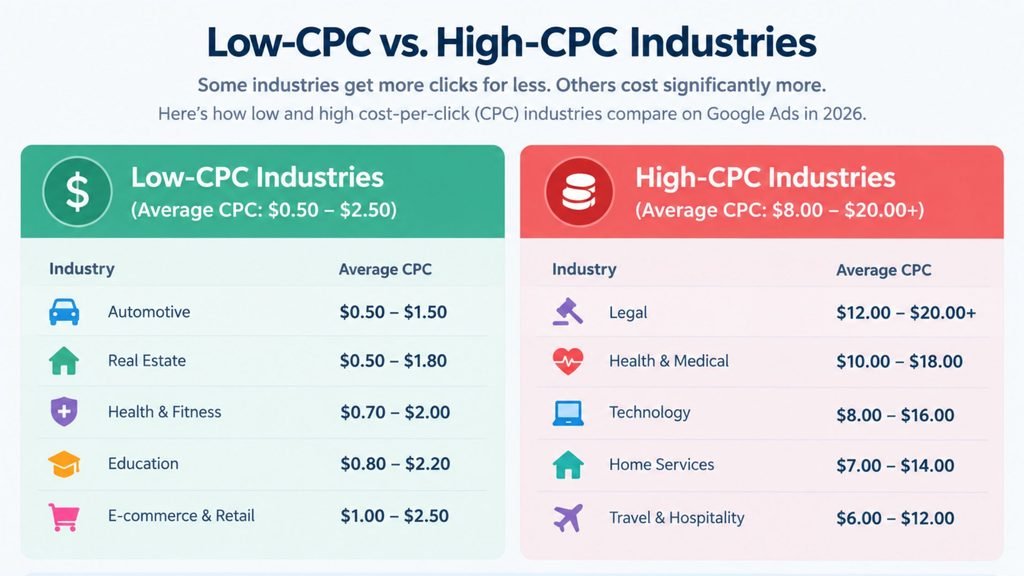
Neither, on its own. A high cpc for google ads only matters in relation to what that click is worth to your business. A $50 CPC sounds alarming until you learn it belongs to a law firm where a single signed client is worth $10,000. A $0.50 CPC sounds great until you learn the resulting traffic almost never converts.
The right question is not “is my CPC good or bad” but “is my cost per conversion acceptable given what a conversion is worth to me.” A dentist paying $8.00 per click but converting one in ten clicks into a booked appointment worth $400 is in a strong position, even though $8.00 looks expensive next to a retail store’s $1.50 CPC.
How to Lower Your CPC Without Losing Traffic
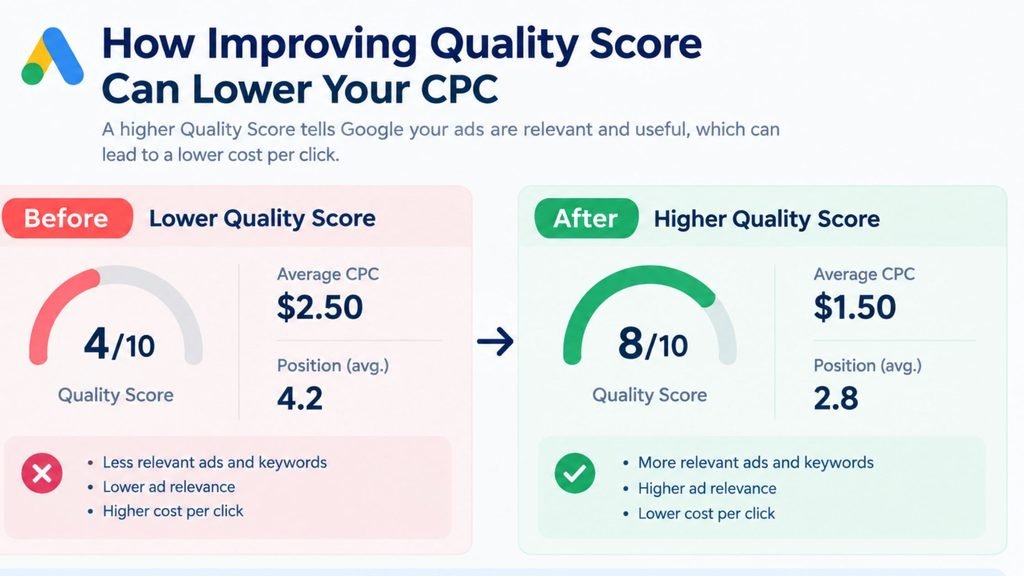
A handful of levers actually move the number. Most of them come back to relevance rather than raw budget:
- Improve your Quality Score by tightening the match between your keywords, ad copy and landing page content. A one-point improvement in Quality Score can meaningfully reduce what you pay for the same ad position.
- Narrow your match types so your ads only show for searches that closely match real buying intent, rather than paying for broad, loosely related traffic.
- Use negative keywords aggressively to stop paying for clicks from searches that were never going to convert in the first place.
- Test ad copy variations regularly, since a higher click-through rate on your ad directly feeds into a better Quality Score and a lower effective CPC.
- Reconsider your bidding strategy. Manual bidding gives more control over individual keyword costs, while automated Smart Bidding can find efficiencies at scale once it has enough conversion data to work with.
Manual CPC vs Automated Bidding: Where the Number Actually Comes From
A lot of confusion about cpc meaning google ads comes from not knowing where the number is actually set. With manual CPC bidding, you set a maximum you are willing to pay per click on a given keyword. The actual price you pay is usually somewhat lower than that maximum though, determined by the auction. With automated Smart Bidding strategies, you do not set a CPC at all. You set a target outcome, like a target cost per acquisition. Google’s algorithm then adjusts your effective CPC automatically, sometimes bidding more on a promising click and less on a weaker one within the same campaign.
This matters because “how to change cpc in google ads” means something different depending on which mode you are in. Under manual bidding, you literally edit the maximum CPC field on each keyword. Under automated bidding, you cannot set a CPC directly. Instead, you adjust your target cost per acquisition or target return on ad spend. The algorithm then reworks its effective CPC across your account to try to hit that target.
Reading Your Own CPC Data Correctly
Before deciding your google ads cpc is too high or too low, look at it over the right window. A single day of unusually high or low CPC rarely means anything, since daily auction dynamics shift with competitor activity you cannot see. A meaningful read usually needs at least two to four weeks of data. Even then it should be broken down by campaign and ad group rather than viewed as one blended account-wide number.
It also helps to separate your CPC by match type. Broad match keywords often carry a different average cost per click than exact match keywords for the same core term, because broad match exposes your ad to a wider, less predictable range of searches. Blending both together into a single “my CPC” figure can hide a specific, fixable problem inside one match type while the other performs fine.
Turning Your CPC Into an Actual Budget
Once you know your realistic google ads cost per click, the number stops being trivia and becomes the input for a real budget calculation. The formula is straightforward: divide your target number of clicks by your CPC to estimate spend. Or work backward from a conversion goal using your conversion rate instead.
Worked Example: From CPC to Monthly Budget
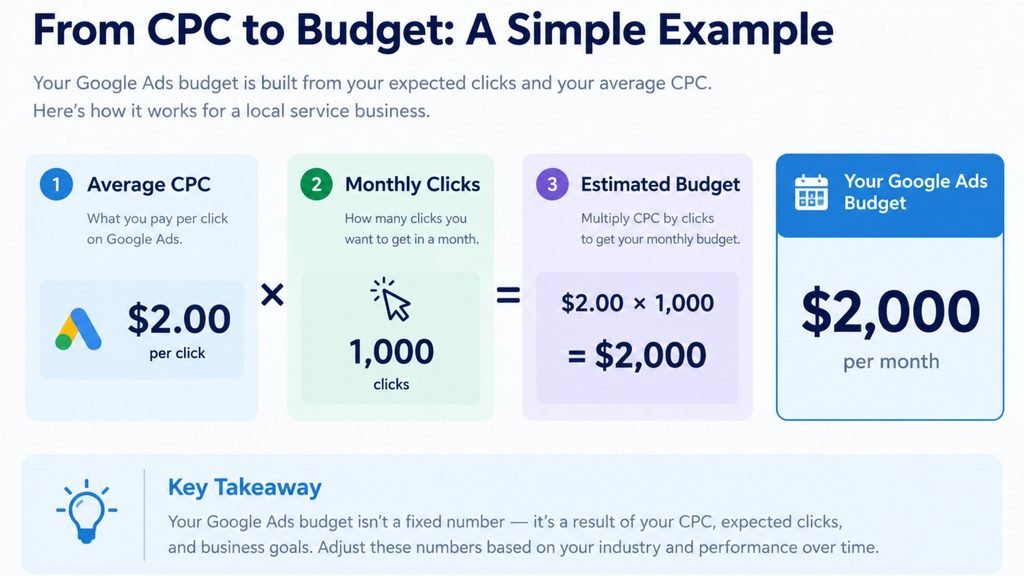
Take a home improvement contractor with a google ad price of $6.50 per click and a website that converts 8 percent of visitors into a request for a quote.
| Input | Value |
|---|---|
| Industry | Home improvement |
| Average CPC | $6.50 |
| Target quote requests | 25 per month |
| Website conversion rate | 8 percent |
| Clicks needed | 313 per month |
| Estimated monthly budget | $2,035 |
Working backward from a conversion goal instead of guessing at a round budget number is what separates a grounded google ads price per click estimate from a shot in the dark. Run your own CPC and conversion numbers through the Google Ads CPC Calculator to get a budget figure specific to your business rather than reusing this contractor’s numbers directly. Once you have that figure, the Google Ads Budget Calculator can help you plan how to allocate it across campaigns and ad groups.
When a High CPC Means You Should Look at SEO Instead
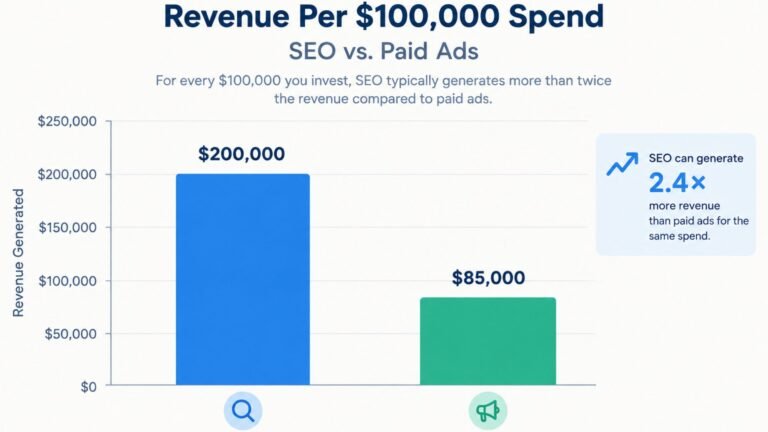
If your industry’s average cpc puts a realistic monthly budget out of reach, that is a legitimate signal to shift more weight toward SEO rather than trying to force a paid campaign to work on too small a budget. A $9.00 CPC industry needing 300 monthly clicks to hit its goals is looking at a budget most small businesses cannot sustain indefinitely, while the same traffic built through organic rankings carries no per-click cost once it ranks. Compare your numbers using the SEO Budget Calculator alongside your CPC-based budget estimate before committing fully to either channel.
How Device and Location Bid Adjustments Affect Your CPC
Two settings quietly move your google ads rate more than most advertisers realize: device and location bid adjustments. Mobile CPCs often run lower than desktop CPCs for the same keyword. Mobile traffic can also convert at a different rate though depending on your business, so a lower mobile CPC is not automatically a better deal. Reviewing performance by device before assuming your blended CPC tells the full story often reveals that one device is quietly dragging down your overall numbers while the other is performing well above average.
Location bid adjustments work the same way. A single campaign covering an entire state or country blends together neighborhoods and cities with very different competition levels into one CPC figure. A contractor bidding the same amount across an entire metro area may be overpaying in a low-competition suburb while underbidding in the dense urban core where the real demand sits. Splitting a broad campaign into smaller geographic segments, even within the same city, often reveals a CPC spread wide enough to justify different bid levels for each area.
Common Mistakes When Judging Your CPC
- Comparing your CPC against the overall cross-industry average instead of your specific vertical, which makes a perfectly normal number look alarming or a genuinely high number look fine.
- Chasing a lower CPC by loosening targeting, which often lowers cost per click while quietly lowering conversion rate even more.
- Ignoring Quality Score entirely and assuming CPC can only be controlled through bid amount.
- Judging CPC in isolation instead of alongside conversion rate and the actual value of a conversion.
- Never revisiting CPC benchmarks, even though they shift meaningfully year over year as competition in a given industry changes.
Worked Example: Comparing Manual and Automated Bidding on the Same Budget
Take a personal injury law firm currently running manual CPC bidding at $9.50 per click, spending $2,850 a month for 300 clicks and converting 2 percent of those clicks into signed cases.
| Approach | Average CPC | Monthly Clicks | Conversions |
|---|---|---|---|
| Manual CPC bidding | $9.50 | 300 | 6 |
| Target CPA automated bidding | $8.20 (algorithm-optimized) | 348 | 8 |
The same $2,850 budget produced more clicks and more conversions once the firm switched to automated bidding, because the algorithm redistributed spend toward the searches most likely to convert rather than treating every click within the keyword’s max bid as equally valuable. This does not mean automated bidding always wins. It generally needs the 30 or more monthly conversions mentioned earlier to optimize well, so a much smaller account may still be better served by manual bidding until it builds up enough conversion volume.
Frequently Asked Questions
Should I use manual or automated bidding to control my CPC?
Manual bidding gives direct control over each keyword’s maximum cost per click, which suits smaller accounts still building conversion history. Automated bidding generally performs better once an account has enough monthly conversions, usually 30 or more, for the algorithm to optimize effectively.
How long should I wait before judging my CPC as too high?
Give it at least two to four weeks of data before drawing conclusions. Look at CPC broken down by campaign, ad group and match type too, rather than one blended account-wide number, since daily fluctuations rarely mean anything on their own.
What is a good CPC for Google Ads?
It depends entirely on your industry. A good cpc for google ads might be under $2.00 in retail or travel, while $6.00 to $10.00 is normal and even expected in legal services or home improvement.
Is a low CPC always better?
Not necessarily. A low CPC paired with a low conversion rate can cost more per actual customer than a higher CPC that converts well. Cost per conversion matters more than cost per click on its own.
What does CPC mean in Google Ads?
CPC stands for cost per click, the amount you pay each time someone clicks your ad. It is determined through a real-time auction influenced by competition, Quality Score and targeting settings.
How do I lower my Google Ads CPC?
Improve your Quality Score through tighter keyword, ad copy and landing page alignment. Narrow your match types too. Use negative keywords as well to cut spend on searches that were never going to convert.
Why is my CPC higher than industry average?
Higher competition in your specific market, broader match types, a lower Quality Score or targeting a major metro area can all push your CPC above the general industry figure, even if your account is otherwise healthy.
Should I switch to SEO if my CPC is too high?
Not necessarily. A very high CPC in your industry is a good reason though to compare the long-term cost of ads against SEO for the same traffic goal, since organic rankings carry no per-click cost once achieved.
3 Comments