How to Calculate Your Break-Even Point (2026 Guide)
A freelancer who prices a new service without checking break-even is guessing whether the work pays for itself. Break-even isn’t complicated math. Skip it and you won’t know if three clients a month covers your costs or leaves you short. Here’s how to calculate it properly, with a real worked example.
What Break-Even Point Actually Means
Break-even point is the level of sales, in units or in revenue, where total income exactly equals total costs. Below it, you’re losing money. Above it, everything extra is profit. At exactly break-even, you’re neither.
It’s not a target to aim for. It’s the floor underneath whatever target you actually want. Capital One frames break-even analysis as a way to understand how much you need to sell before a product or service becomes profitable, which is exactly the question a freelancer or agency needs answered before committing to a new price or a new service line.
Break-even shows up under a few different names depending on where you read about it: breakeven point, BEP, the break-even calculation. They’re all the same concept. What changes between sources is usually just whether the answer is expressed in units sold or in dollars of revenue, not the underlying math.
The Break-Even Formula
nemin.io’s Break-Even Calculator uses this formula directly:
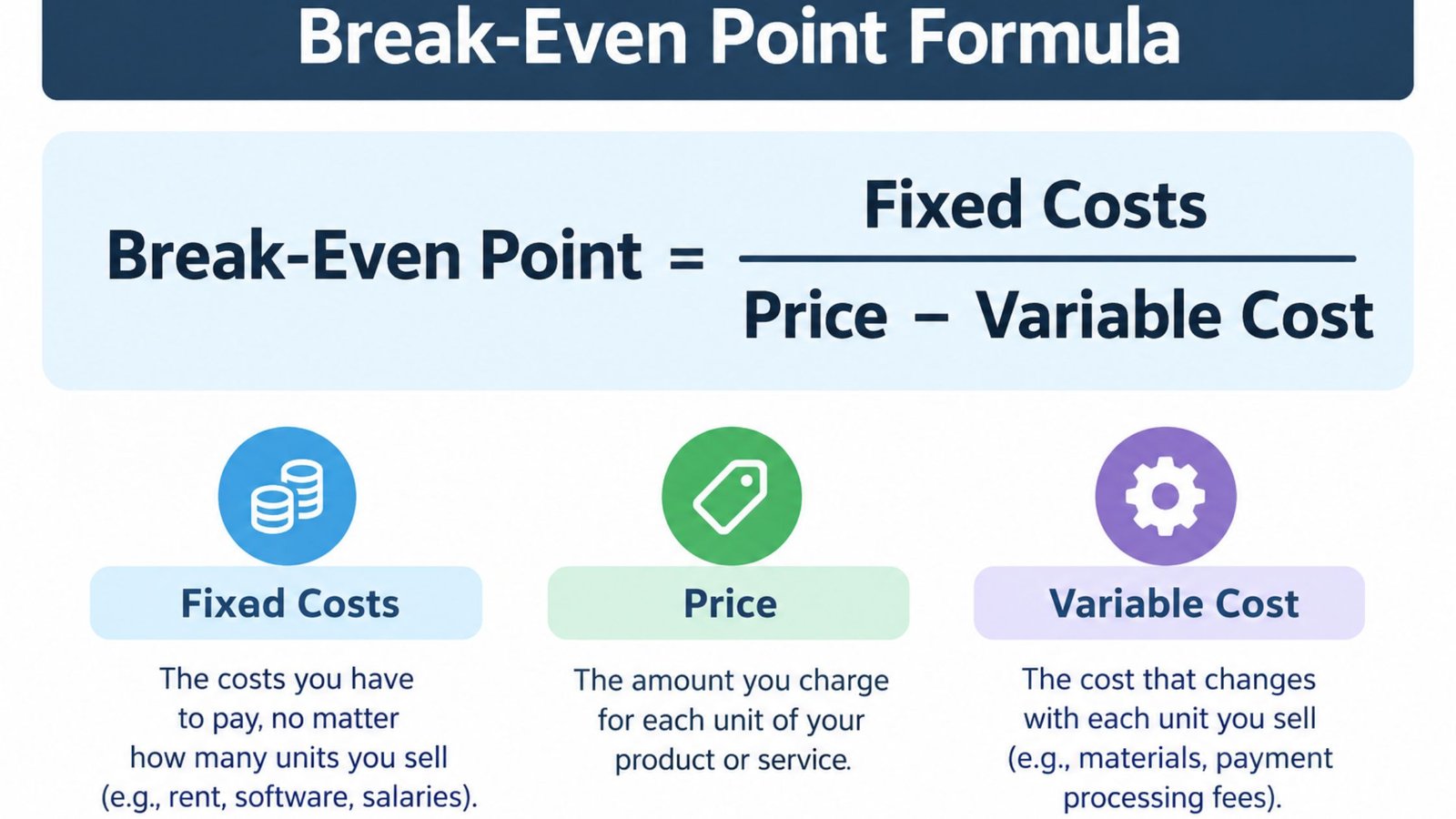
Break-Even (units) = Fixed Costs ÷ (Price − Variable Cost per Unit)
Three inputs. Fixed costs stay the same no matter how much you sell. Price is what you charge per unit, project or client. Variable cost per unit is what it costs you to deliver one more of whatever you’re selling. The gap between price and variable cost, called the contribution margin, is what actually pays down your fixed costs. Divide fixed costs by that gap and you get the number of units it takes to cover everything.
Step 1: Add Up Your Fixed Costs
Fixed costs don’t move with volume. Whether you complete one project this month or ten, these stay the same:
- Software and subscriptions
- Business insurance
- A coworking desk or office rent
- Retainer-based tools like accounting or bookkeeping software
- Any baseline salary you pay yourself before profit, if you’re treating that as a fixed cost rather than the thing break-even is solving for
Add these up on a monthly basis, since most freelancers and agencies think in monthly cycles for planning.
Step 2: Find Your Variable Cost per Unit
Variable costs move with each sale. If you take on a subcontractor for a specific project, pay a per-project software license or buy materials for one client’s work, that’s variable, not fixed.
Divide total variable spend by the number of units it produced to get a per-unit figure. A freelance designer who spends $450 a month on stock assets across three client projects has a variable cost of $150 per project.
Step 3: Set Your Price per Unit
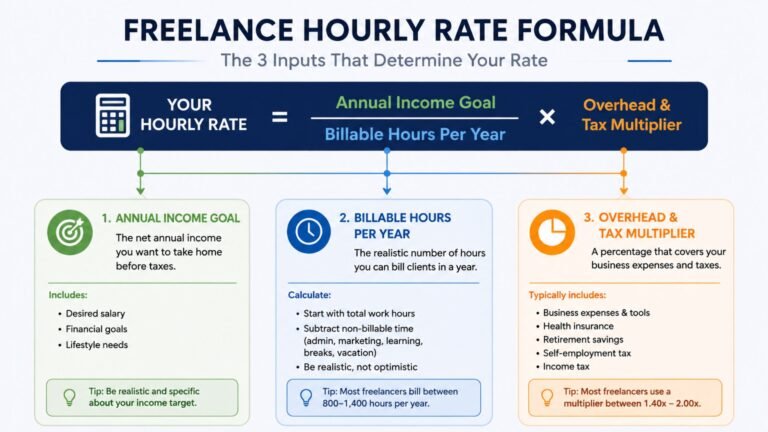
This is what you already charge or what you’re testing for a new service. If you haven’t set a rate yet, this is where article #1’s hourly rate math connects directly, since your price per unit for hourly work should already reflect the number you calculated there.
Worked Example: Calculating Break-Even Step by Step
A freelance graphic designer wants to launch a flat-rate logo package.
| Input | Amount |
| Fixed costs (monthly) | $800 |
| Price per package | $500 |
| Variable cost per package | $150 |
| Contribution margin (price minus variable cost) | $350 |
| Break-even point | 2.29 packages, round up to 3 |
The math: $800 ÷ ($500 − $150) = $800 ÷ $350 = 2.29. Since you can’t sell a fraction of a package, round up. Selling 3 packages a month covers fixed costs with a small buffer left over. Anything past 3 packages is where actual profit starts.
Break-Even Price: Flipping the Formula Around
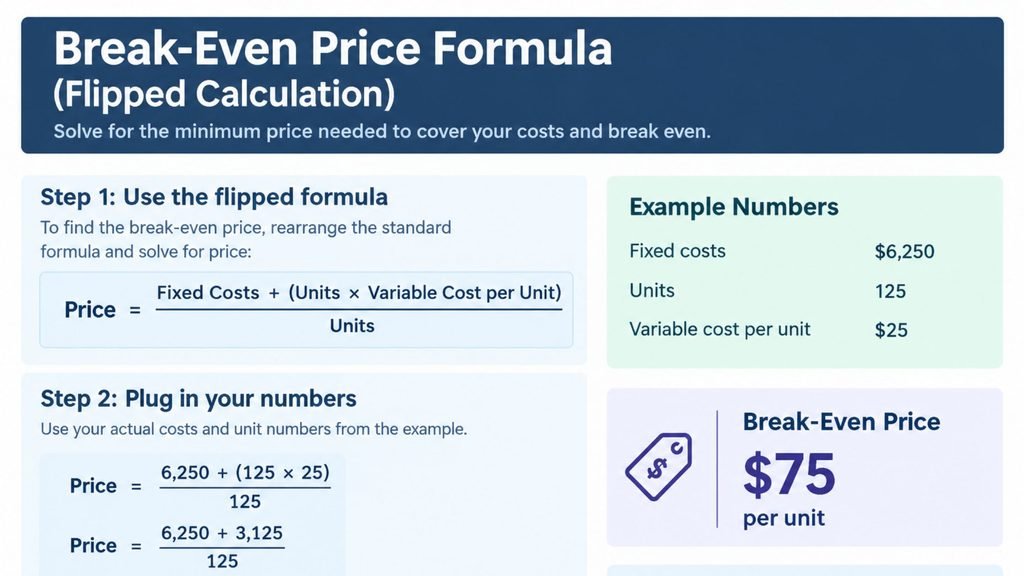
Sometimes the question runs the other direction. Instead of “how many do I need to sell,” it’s “what’s the minimum I can charge.” If the designer above can only realistically take on 4 packages a month due to time constraints, the break-even price formula answers what price covers costs at that volume:
Break-Even Price = (Fixed Costs ÷ Units) + Variable Cost per Unit
At 4 packages: ($800 ÷ 4) + $150 = $200 + $150 = $350 per package minimum. Anything charged below $350 at that volume means the month doesn’t cover its own costs, even before counting time as a cost at all.
Break-Even in Units vs Break-Even in Revenue
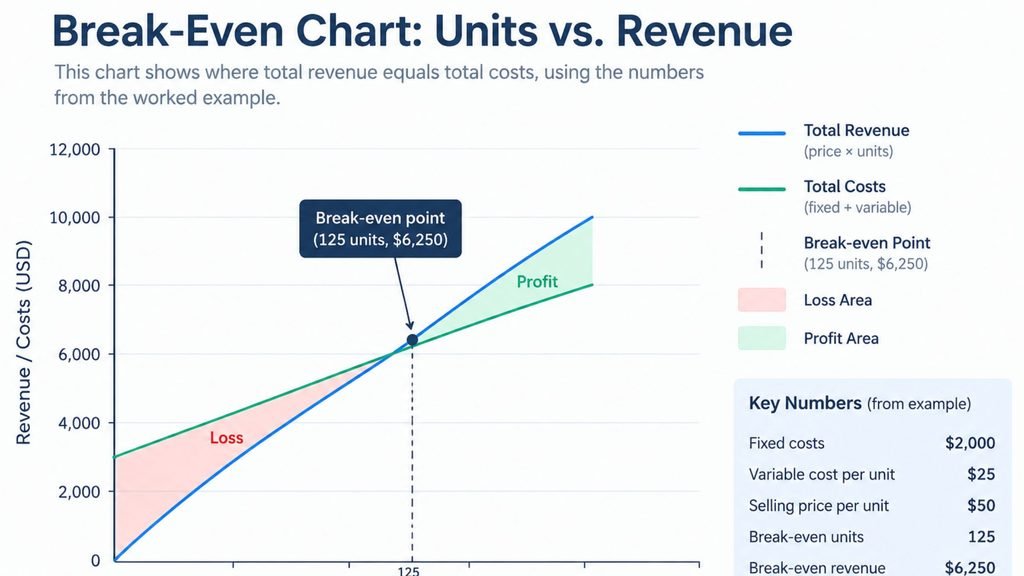
The formula above gives break-even in units, packages, projects or hours sold. To convert to a revenue figure, multiply by price: 3 packages × $500 = $1,500 in monthly revenue to break even. Some freelancers find the revenue version more useful for monthly planning, since it’s a single dollar figure to watch rather than a count of specific projects.
Which version to track depends on how your work is structured. Project-based freelancers and agencies usually think in units, since a specific number of clients or packages is easier to plan a month around than a revenue target alone. Freelancers billing hourly or anyone whose “unit” varies in size from client to client usually get more use out of the revenue figure, since hours or project scope shift too much for a fixed unit count to stay meaningful month to month. Either version comes from the same underlying calculation, so switching between them later doesn’t require redoing the math, only multiplying or dividing by price.
Why Break-Even Changes the Rate and Margin Conversation
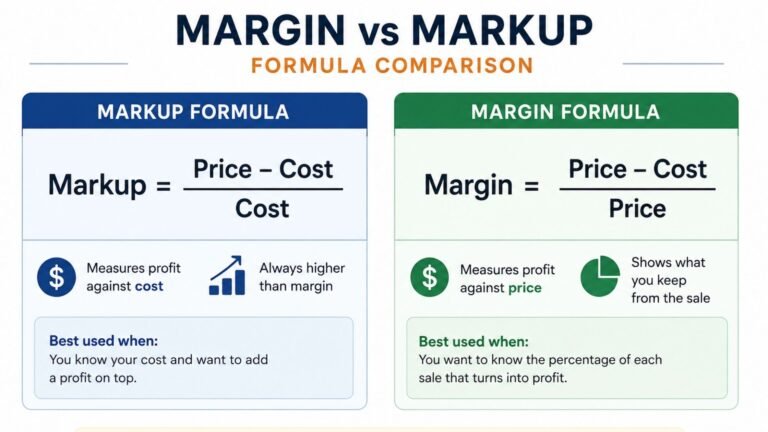
Break-even is the third piece of a check that article #1 and article #2 both pointed toward without completing. The hourly rate math tells you what to charge per hour. The margin and markup breakdown tells you whether a specific job is actually profitable once costs are accounted for. Break-even tells you the minimum volume before either number matters at all.
A rate that looks healthy and a margin that looks healthy can still leave a new service line underwater if the volume needed to hit break-even isn’t realistic. Checking all three before committing to a new price catches a mistake that checking any single one misses.
How to Lower Your Break-Even Point
Once you’ve calculated a break-even number that feels too high, three levers actually move it. Raising your price per unit has the biggest single effect, since it widens the contribution margin directly, the same gap the whole formula runs on. Cutting a fixed cost helps too, though usually by less, since fixed costs tend to be smaller relative to the total than people expect once they’ve been itemized.
The third lever, reducing variable cost per unit, matters most for freelancers and agencies that route work through subcontractors or licensed materials. Renegotiating a subcontractor rate or switching to a cheaper license tier lowers the variable cost side of the formula without touching price at all, which is often the least disruptive change to make first, since it doesn’t affect what clients pay or notice.
Running the numbers with each lever separately, rather than guessing which one matters most, is exactly what a calculator is for.
Common Mistakes When Calculating Break-Even
- Leaving out small fixed costs. A $30 tool here and a $50 subscription there adds up to real money against a monthly break-even target.
- Treating a variable cost as fixed or the reverse. A subcontractor paid per project is variable. A subcontractor on a flat monthly retainer regardless of volume is fixed. Mixing these up skews the whole calculation.
- Forgetting to round up units. Break-even in units almost never lands on a whole number. Rounding down leaves you short of actual break-even, not at it.
- Calculating once and never rechecking. Fixed costs shift when a subscription price changes or you add a tool. Variable costs shift when a supplier or subcontractor rate moves. An old break-even number can quietly stop matching reality.
- Skipping the price-per-unit sanity check. A break-even calculation that assumes an unrealistic number of monthly sales isn’t a business plan, it’s a spreadsheet exercise. Compare the required units against your actual realistic capacity, the same check the worked example above walks through.
FAQs
How do you calculate break-even point?
Divide your fixed costs by the difference between your price per unit and your variable cost per unit. The result is the number of units, projects or clients you need to sell before you’ve covered your costs and started earning profit.
What is break-even point in simple terms?
It’s the point where what you’ve earned exactly equals what you’ve spent. Below that point, you’re losing money. Above it, you’re making a profit. It’s not a goal to reach, it’s the minimum before any real profit starts.
What is the break-even formula?
Break-Even (units) = Fixed Costs ÷ (Price − Variable Cost per Unit). A break-even price formula also exists for the reverse question, working out the minimum price needed at a known volume: Break-Even Price = (Fixed Costs ÷ Units) + Variable Cost per Unit.
How do you find break-even point in units versus revenue?
Break-even in units comes directly from the standard formula. To convert to revenue, multiply the unit result by your price per unit. Both describe the same break-even point, just in different terms, projects sold versus dollars earned.
What’s a common mistake when calculating break-even?
Misclassifying a cost as fixed when it’s actually variable or the reverse. A subcontractor paid per project is variable. A flat monthly retainer paid regardless of workload is fixed. Getting this wrong skews the entire calculation, not just one input.
How often should I recalculate my break-even point?
Any time a fixed cost changes, a subcontractor or supplier rate moves or you’re pricing a new service line. A break-even number calculated a year ago on different costs isn’t reliable for a decision you’re making today.
How can I lower my break-even point?
Three ways: raise your price, cut a fixed cost or lower your variable cost per unit, most often by renegotiating a subcontractor rate or switching to a cheaper materials or software tier. Raising price usually has the biggest effect, since it directly widens the contribution margin the whole formula depends on.