SEO vs PPC: How to Split Your Budget in 2026
You have a marketing budget and two people telling you two different things. One says SEO is the only channel worth investing in because it compounds forever. The other says PPC is the only channel that actually delivers before your runway runs out. Both of them are citing a real advantage. Neither of them is giving you the full picture, because the honest answer is not SEO or PPC. It is how much of each. It is also when. Below is what the actual ROI data shows for both channels, plus a workable framework for splitting your budget between them instead of picking a side and hoping it was the right one.
SEO vs PPC: what you are actually paying for
SEO and PPC are not two flavors of the same thing. They are two completely different transactions.
With PPC, you rent your visibility. The moment you stop paying, your traffic stops. Every click has a direct, attributable cost. That cost holds steady at best. It typically rises as competition for your keywords increases, for as long as you keep the campaign running.
With SEO, you build an asset. There is no per-click charge once a page ranks. The cost sits upfront in the work of creating and optimizing content, then the traffic keeps arriving without a matching invoice every time someone lands on the page. The tradeoff is time. Rankings do not appear the day you publish.
That single difference, rented visibility versus an owned asset, is the reason the “seo vs ppc” debate never has a clean winner. You are comparing a subscription to a slow-appreciating investment.
What the actual ROI data shows
Set the opinions aside. Here is what gets measured when researchers actually compare the two channels head to head.
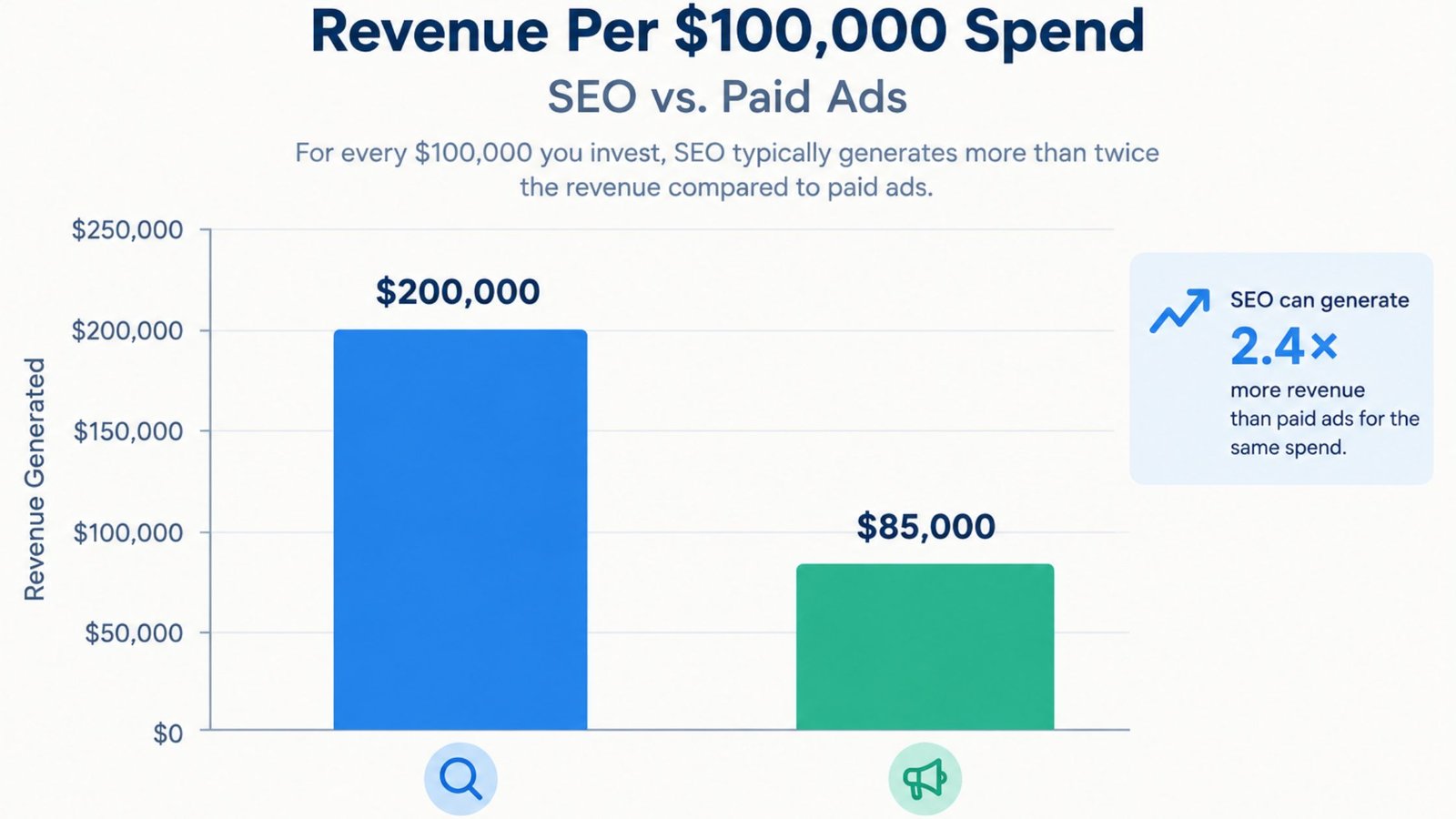
A Victorious study found that a $100,000 annual budget returned $51,724.20 in revenue when spent on SEO, compared to $23,275.86 when spent on paid ads. That is over twice the revenue for the same spend. It is the single strongest data point in the seo vs ppc roi conversation. It is also the main reason SEO tends to win any long-term comparison once results have had time to mature.
Traffic share tells a closer story. Backlinko’s research puts organic search at 26.7 percent of total website visits against 23 percent for paid search, a narrow gap rather than the landslide the revenue number might suggest. Paid traffic still shows up in real volume. It simply costs more per visit to get it there.
Conversion behavior varies by source in ways that matter more than the channel label itself. HigherVisibility reports the average paid search conversion rate across industries sits around 3.75 percent in 2024. A separate e-commerce case study from DotCom Infoway found SEO visitors converting at 2.4 percent against 1.3 percent for PPC visitors on the same site, the opposite pattern. The lesson is not that one channel always converts better. It is that conversion rate depends heavily on your specific industry, your offer and your landing page experience. Treat any single average as a starting benchmark rather than a guarantee for your own business.
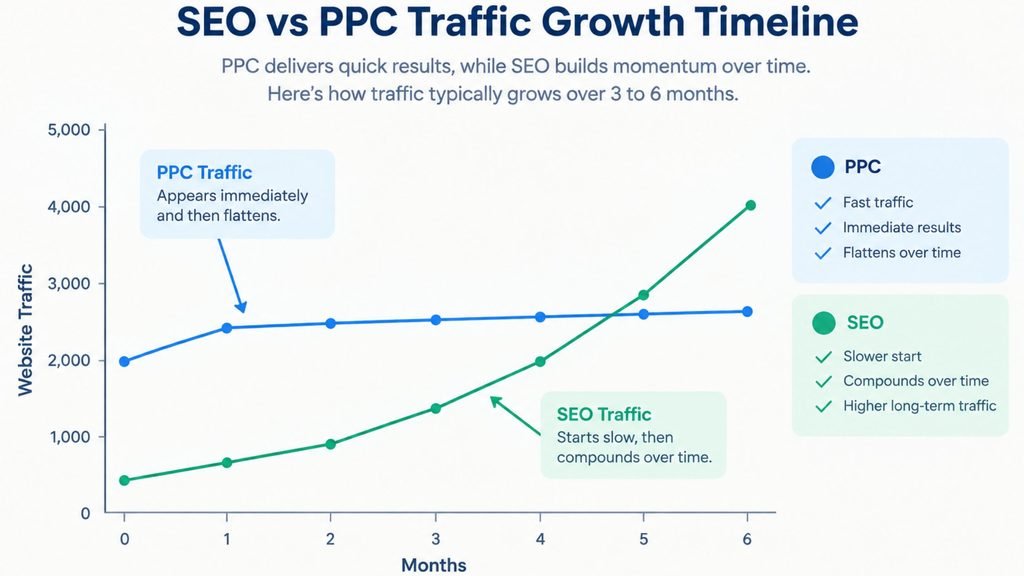
Speed is where PPC has no real competition. A campaign can be live and generating clicks within hours of launch. SEO, even done well, typically needs 3 to 6 months before it produces meaningful, reliable traffic. If your runway is measured in weeks, that timeline gap alone can decide the question for you regardless of what the revenue numbers say.
When PPC should get the bigger share
A few situations genuinely favor loading your budget toward PPC first.
You have a hard deadline. A product launch, a seasonal window or a funding milestone that needs proof of traction this quarter leaves no room for SEO’s 3 to 6 month runway.
You are testing a new offer or market. PPC gives you fast, direct data on which keywords and messages actually convert before you commit months of content production to the wrong angle.
Your site has no organic foundation yet. A brand-new domain with no backlinks and no indexed content is starting from zero on SEO. PPC can generate revenue while that foundation gets built in parallel.
When SEO should get the bigger share
The reverse situations tilt the split the other way.
You already have some organic traction. If parts of your site already rank, additional SEO investment compounds on top of existing authority instead of starting cold, which shortens the usual timeline.
Your market has high, sustained PPC competition. In categories where cost per click keeps climbing (the same dynamic covered in the Google Ads budget and CPC articles in this series), the cost of staying visible through ads alone can outpace what the traffic is worth, making the owned-asset economics of SEO more attractive.
You are building for the long term, not the next quarter. A business with 12 months or more of runway captures more of that 2x revenue advantage the longer SEO has to mature.
How to actually split the budget
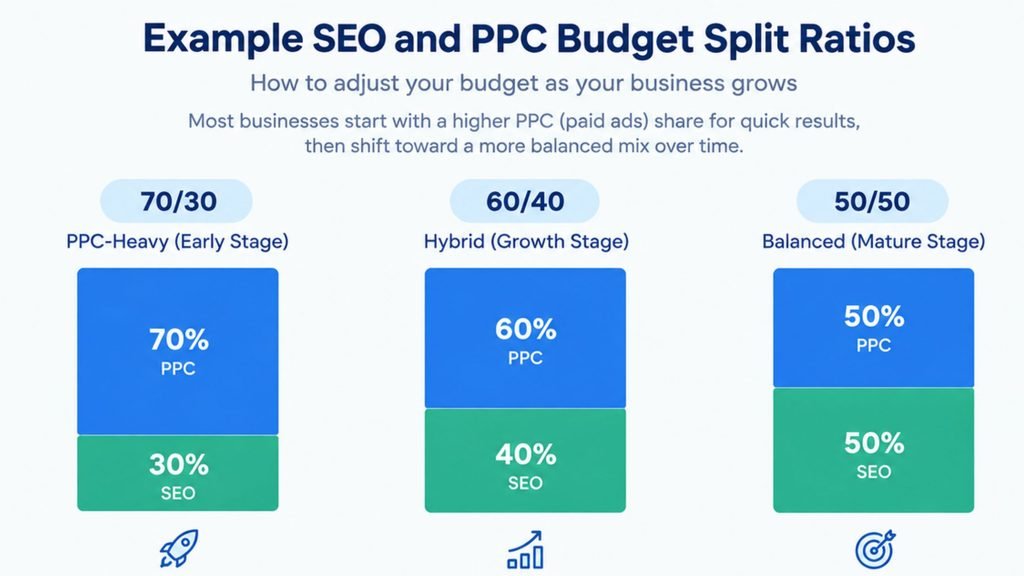
Search Engine Journal’s budget-mix framework offers concrete starting ratios rather than a vague “do both.”
Early-stage businesses commonly start around a 70/30 or 60/40 split favoring PPC, since there is no organic traffic yet to lean on. As rankings build and organic traffic starts contributing real volume, that ratio shifts toward 50/50, then can tip toward SEO-heavy once the site has enough authority that paid spend becomes a smaller share of total traffic.
A hypothetical $100,000 annual budget split 80/20 toward PPC illustrates the tradeoff in concrete terms. The $80,000 PPC portion, at roughly $3.20 average cost per click and a 2 percent conversion rate, works out to around 25,000 paid clicks and 500 conversions. The $20,000 SEO portion, spent on content production, might fund around four high-quality articles a month, with a 3 to 6 month lag before that investment shows up as meaningful ranking traffic. Neither allocation is wrong. They simply produce results on different timelines, which is exactly why most businesses run both rather than choosing one.
Worked example: a $10,000 monthly budget across two business stages
| Business stage | PPC allocation | SEO allocation | Rationale |
|---|---|---|---|
| Month 1, brand new site | $7,000 (70%) | $3,000 (30%) | No organic traffic yet, PPC covers the gap while content gets published |
| Month 9, after early rankings land | $5,000 (50%) | $5,000 (50%) | Some pages now rank, SEO starts pulling its own weight alongside PPC |
| Month 18, established rankings | $3,500 (35%) | $6,500 (65%) | Organic traffic now covers a growing share of demand, PPC fills remaining gaps |
Notice that the dollar amounts stay flat across the three stages in this example while the split inside them moves. That is deliberate. The goal of rebalancing is rarely to spend more overall. It is to spend the same total more efficiently as one channel earns its keep and the other channel’s marginal returns start to soften. Run your own numbers, your current traffic mix and your target timeline through the SEO vs Ads Split Calculator to get a starting ratio specific to your situation instead of copying a generic table.
Blended CAC: the number that tells you if your split is working
Most businesses track PPC cost per lead and SEO traffic growth as two separate scorecards. That habit hides the number that actually matters: blended customer acquisition cost, meaning total marketing spend across both channels divided by total customers acquired from both channels combined.
Here is why the blended view changes the picture. Say a business spends $5,000 a month on PPC and generates 40 customers at $125 each. The same month, $5,000 goes to SEO, which is still building toward its first real ranking and generates 5 customers at $1,000 each. Judged channel by channel, SEO looks like a disaster next to PPC. Judged as a blend, the combined $10,000 spend produced 45 customers at roughly $222 each. That blended figure is the one worth comparing against last quarter’s number, not either channel’s figure taken in isolation.
The reason this matters so much is that SEO’s cost per customer looks worst in exactly the months where the underlying asset is closest to paying off. A page that is three months into ranking and about to break onto page one looks identical, on paper, to a page that will never rank at all. Cutting SEO spend based on a single bad month’s channel-level number is how businesses quit right before the investment turns.
Track blended CAC monthly. Track it against your target, not against the previous month’s PPC number specifically, since the two channels move on different clocks and comparing them directly always makes SEO look worse than it is early on.
Industry factors that shift the split further
The 70/30 starting point is a generic default, not a fixed rule. A few industry-specific patterns push most businesses off it in a fairly predictable direction, worth understanding before you lock in any single ratio for the whole year.
Local, trade-based services (the same category covered in this series’ Local Service Ads cost article) tend to see faster SEO payoff than national or highly competitive categories, because local search competition is thinner and a handful of well-optimized pages can rank within a shorter window than the general 3 to 6 month estimate. These businesses can often shift toward SEO earlier than the default framework suggests.
Highly competitive national categories, legal services and SaaS being common examples, see the opposite pattern. Cost per click runs higher and content-ranking difficulty climbs right alongside it, which stretches the SEO timeline out well past the general 3 to 6 month estimate. That combination keeps the effective floor for PPC spend higher for longer in these categories, simply because outranking established competitors takes more content, more links and more time than it does in a thinner local market.
A business selling to consumers in a single metro area and a SaaS company selling nationally can both start at 70/30. Twelve months later they can land in very different places for exactly this reason. The framework is a starting point. The category you compete in decides how fast you can responsibly move off it.
The mistake most businesses make
The most expensive mistake in this decision is not picking the wrong ratio. It is picking a side and refusing to revisit it.
A common pattern: a business starts PPC-heavy out of necessity, gets a working funnel and then never reallocates as SEO traction builds, because the PPC numbers already feel proven and nobody wants to touch what is working. That leaves money on the table that could shift into an asset that gets cheaper per lead every month instead of staying flat.
The opposite mistake shows up just as often. A business invests in SEO cost for six months, sees nothing yet because that is a normal part of the timeline, panics and pulls the budget right before it was about to pay off. Watch blended CAC month over month instead of judging either channel in isolation. Revisit the split on a fixed schedule, quarterly is a reasonable default, rather than reacting to any single bad week.
Frequently asked questions
Is SEO better than PPC?
Neither wins outright. Victorious found that a $100,000 annual budget returned $51,724 in revenue through SEO versus $23,275 through paid ads, over twice as much. PPC still wins on speed, showing results within hours instead of the 3 to 6 months SEO typically needs to build traction.
Should I do SEO or PPC first?
If you need customers this month, start with PPC and layer SEO in behind it. If you have a runway of 6 months or more and want compounding results, start SEO early even at a smaller budget, since it takes that long to build traction regardless of when you start.
What is a good SEO and PPC budget split?
Search Engine Journal outlines common starting ratios of 70/30 or 60/40 favoring PPC for early-stage businesses, shifting toward 50/50 as organic rankings build. The right split depends on your timeline, your competition and how established your site already is.
Do SEO and PPC leads convert differently?
In a DotCom Infoway case study, SEO visitors converted at 2.4 percent versus 1.3 percent from PPC on the same site. Separately, HigherVisibility reports the paid search average conversion rate across industries sits around 3.75 percent. Results vary by industry and traffic quality more than by channel alone.
Can SEO and PPC work together?
Yes. Most mature marketing budgets run both at once rather than choosing one. PPC data on which keywords actually convert can guide which pages you prioritize for SEO. SEO rankings reduce your dependence on paid clicks over time, lowering your blended acquisition cost.
How long until SEO beats PPC on ROI?
Most sources put meaningful SEO traction at 3 to 6 months, with returns continuing to compound after that as rankings hold without an ongoing per-click cost. PPC delivers from the first day but keeps costing the same per lead indefinitely. That is why SEO tends to overtake it on total ROI the longer both channels run.