How Much Should a Business Website Cost in 2026?
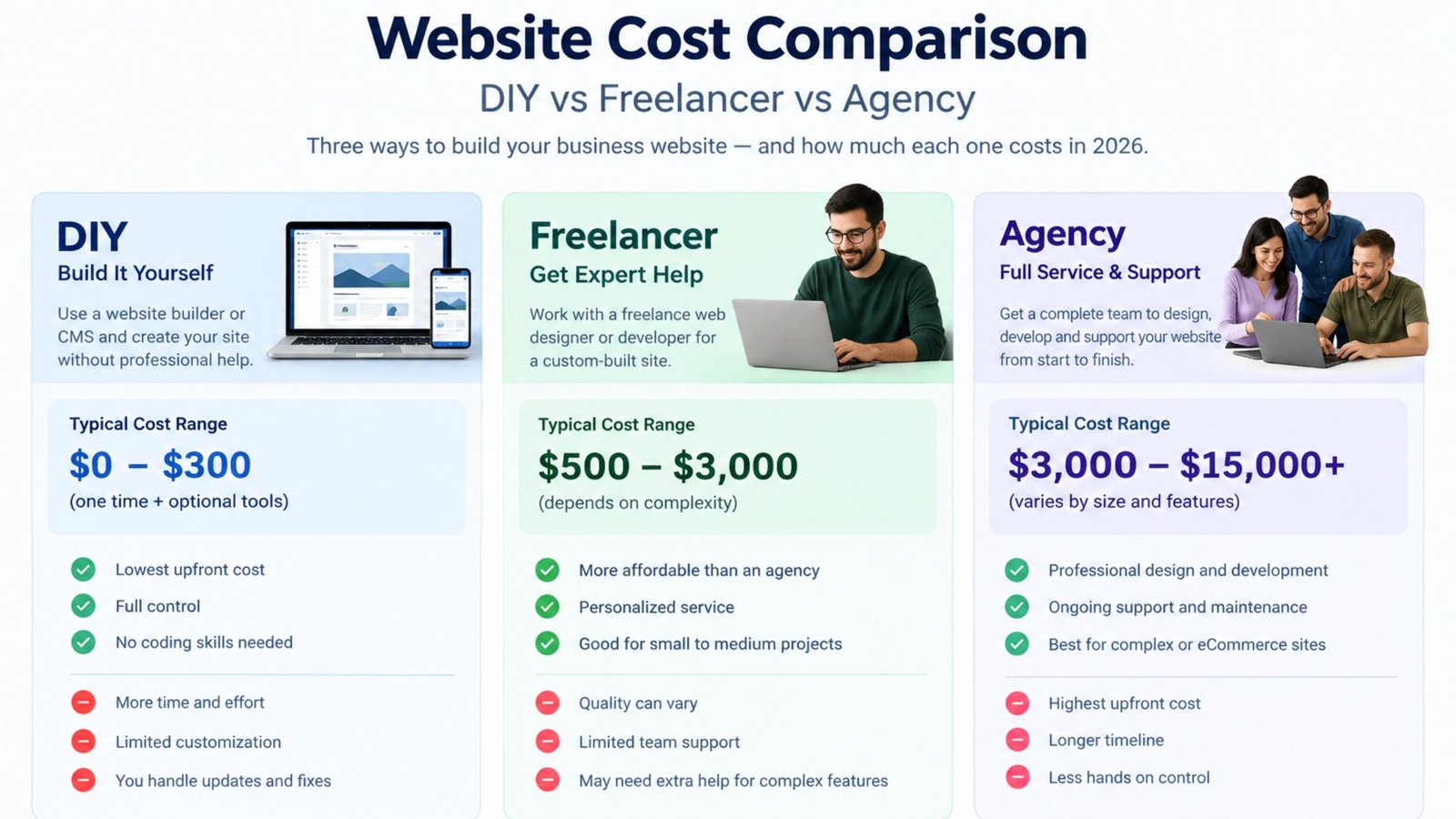
Search “how much does a website cost” and you’ll find a dozen articles giving you a range so wide it’s useless, five hundred dollars to fifty thousand. That range exists because it’s answering three different questions at once: what a DIY builder costs, what a freelancer costs and what an agency costs. Split those apart and the numbers actually mean something, which is what the rest of this guide does, tier by tier, with the platform and maintenance costs most versions of this article skip entirely.
What Actually Drives Website Cost
Three things move the price more than anything else: who builds it, how many pages and features the scope includes and how competitive your market is. A five-page brochure site and a fifteen-page site with booking, ecommerce or custom integrations aren’t the same project, even on the same platform, with the same builder. Cost being a leading reason small businesses skip having a website at all shows up directly in industry data. Wix’s 2026 small business survey compilation found cost cited as the primary reason, right behind believing a website isn’t relevant to the business at all.
That’s exactly why a single number is the wrong way to answer this question. What follows breaks the range apart by who’s actually doing the building.
DIY Website Builders: Cost and What You Get
Platforms like Wix, Squarespace and Shopify’s own builder run roughly $200 to $600 a year, mostly as a monthly subscription that bundles hosting in with the platform fee. You do the building yourself using templates and a drag-and-drop editor.
This is the right call if you need to get online fast, your budget is genuinely tight and the site’s job is simple, an online business card more than a conversion engine. The tradeoff is time and a ceiling on customization. A DIY site can look professional in 2026 if you’re willing to put real hours into it. The moment you need something the template doesn’t support, you hit a wall a freelancer or agency wouldn’t.
Freelance-Built Websites: Cost and What You Get
Independent designers and developers typically charge $1,500 to $8,000 for a custom-built site, usually as a one-time project fee separate from ongoing hosting. This is the middle ground: more flexibility and a more custom result than a DIY builder, at a fraction of agency pricing.
Quality varies significantly within that range. A $1,500 freelancer and a $7,000 freelancer are not delivering comparable work, so price alone isn’t a reliable signal, check portfolio and past client sites before committing. The main risk with freelancers isn’t price, it’s continuity. If they become unavailable or slow to respond after launch, you can be stuck without support for a site only they fully understand.
Agency-Built Websites: Cost and What You Get
Agencies typically start around $6,000 and can run $35,000 or more for complex builds. You’re paying for a full team, strategy, design, development and quality assurance, usually with ongoing support bundled in, rather than a single person handling everything.
This tier makes sense when the website is core to revenue, when you’re in a regulated industry with compliance requirements or when you need SEO, content and design coordinated from day one rather than bolted on after launch. For a simple five-page site with no special requirements, an agency is usually more than the project needs.
| Build method | Typical cost | Best for |
| DIY builder | $200-$600/year | Simple sites, tight budget, time available |
| Freelancer | $1,500-$8,000 one-time | Custom design without agency overhead |
| Agency | $6,000-$35,000+ one-time | Revenue-critical sites, complex scope |
Platform and Ecommerce Cost Differences
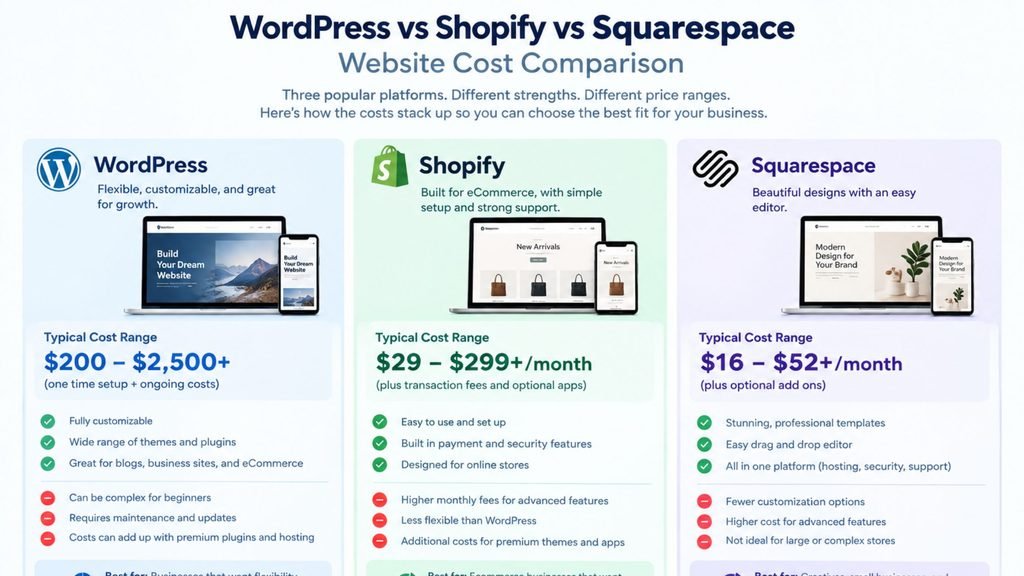
Most cost guides talk about “a website” as if platform doesn’t matter. It does. The search demand behind platform-specific questions backs that up.
Shopify costs more than a standard brochure site even at the DIY tier, since Shopify’s own platform fee runs $29 to $299 a month depending on plan, on top of whatever a freelancer or agency charges to build the store itself. Product catalog setup, payment integration and shipping configuration all add time a standard site doesn’t need, which is why Shopify builds from a freelancer commonly land higher than a comparable non-ecommerce project.
WordPress is the most flexible option and the widest range, since “a WordPress site” can mean a five-page brochure or a fully custom application. Hosting, a domain and common plugins typically run $15 to $40 a month on top of build cost. A custom-built WordPress site from a freelancer commonly falls in the same $1,500 to $8,000 range as other freelance builds, sometimes higher with heavy plugin or custom functionality needs.
Squarespace sits closer to the DIY end by default. Freelance Squarespace builds are common too, typically $3,000 to $6,000 for a full custom build with five to ten pages, since you’re paying for design expertise on a platform that’s simpler to hand off than raw WordPress.
Ecommerce generally costs more than an informational site, regardless of platform, since product catalogs, payment gateways, tax and shipping logic and security requirements all add scope that a five-page brochure site doesn’t carry. This holds true whether the ecommerce build sits on Shopify, WordPress with a plugin like WooCommerce or a custom platform. The added scope is what drives the price up, not the platform choice itself.
Website Maintenance Cost: The Number Everyone Forgets to Budget
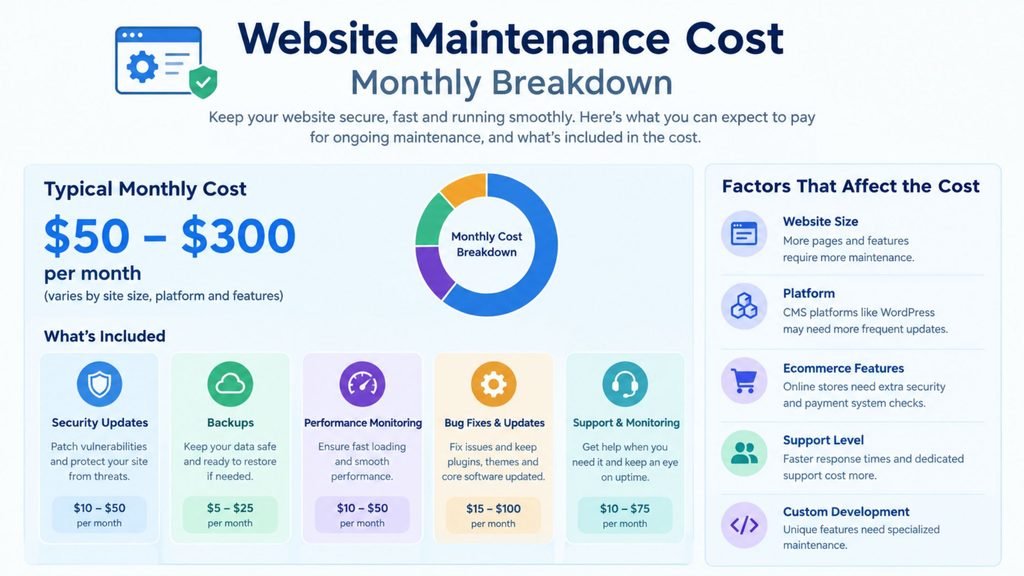
Build cost is a one-time number. Maintenance is ongoing. It’s the line item most first-time website buyers forget to budget for entirely.
Expect $50 to $200 a month for a managed maintenance plan covering updates, backups, uptime monitoring and security patches, more for complex or ecommerce sites with heavier update needs. Self-managing that work yourself, running your own backups and updates, keeps costs closer to just hosting and domain fees, typically $15 to $40 a month. It shifts the time cost back onto you instead.
If you’re comparing a $1,500 DIY-adjacent freelancer build against a $6,000 agency build, run the maintenance cost forward twelve months before deciding. The gap between the two often narrows once a year of upkeep is added to both sides.
Website Redesign Cost: Cheaper Than Starting Over, Usually
A redesign, updating an existing site’s design and structure without starting from a blank page, typically costs less than a full new build, since content, copy and often the information architecture carry over. Redesign pricing generally falls into the same freelancer and agency ranges as a new build, just toward the lower end of each range when the scope is closer to a refresh than a rebuild.
The exception is a full platform migration, moving from one CMS or builder to another entirely. That’s closer to a new build in cost and effort than a redesign, since almost nothing carries over cleanly.
Single Estimate or Package Tiers: Which Number You Actually Need
If you just need a ballpark before a first client call or an internal budget conversation, a single estimate is enough, get a range built for your specific scope rather than guessing from a generic range like the ones above.
If you’re an agency presenting options to a client, a single number isn’t as useful as three. Breaking the same scope into starter, standard and custom tiers gives a client something to choose between instead of a single take-it-or-leave-it figure, closer to how pricing actually gets presented in a real sales conversation.
Common Mistakes When Budgeting for a Website
- Comparing a DIY quote to an agency quote as if they’re the same project. They’re not comparable numbers unless the scope is genuinely identical, which it rarely is.
- Forgetting maintenance entirely. A build-cost budget without twelve months of maintenance layered on top isn’t a full budget.
- Assuming ecommerce costs the same as an informational site. Product catalogs, payment integration and security requirements add real scope, not just a checkbox.
- Picking a platform before knowing the scope. Shopify makes sense for a store, not a five-page consulting site. Matching platform to actual need avoids paying for capability you won’t use.
- Treating a redesign quote and a new-build quote from the same source as automatically different prices. Ask specifically what carries over before assuming a redesign is cheaper.
FAQs
How much should a small business website cost?
Most small businesses spend $200 to $600 a year on a DIY builder, $1,500 to $8,000 one-time for a freelance-built custom site or $6,000 to $35,000 or more for an agency build. Which tier fits depends on how complex the site needs to be and who’s building it, not a single flat number.
Is it cheaper to build a website myself or hire someone?
DIY is cheaper upfront, roughly $200 to $600 a year versus $1,500 or more for a freelancer. The tradeoff is your own time and a ceiling on customization once you need something the template doesn’t support.
How much does website maintenance cost per month?
A managed maintenance plan typically runs $50 to $200 a month, covering updates, backups and security monitoring. Self-managing that work yourself keeps costs closer to just hosting and domain fees, usually $15 to $40 a month.
Does a Shopify website cost more than a regular website?
Usually, yes. Shopify’s own platform fee runs $29 to $299 a month on top of build cost. Ecommerce-specific work, product catalog setup, payment integration and shipping configuration, adds scope a standard informational site doesn’t need.
Is a website redesign cheaper than building a new one?
Generally, yes, since existing content and structure often carry over. The exception is a full platform migration, switching CMS or builder entirely, which is closer to a new build in both cost and effort.
How do I know if I need a single cost estimate or tiered pricing packages?
A single estimate is enough for your own budgeting or a first client conversation. If you’re presenting pricing options to a client, tiered packages, starter, standard and custom, give them something to choose between instead of one number to accept or reject.
Why do website cost estimates vary so much between sources?
Most ranges you’ll find online cover DIY, freelancer and agency pricing all at once without separating them, which produces a range wide enough to be almost meaningless. Once you know which tier you’re actually shopping in, the realistic range for that tier alone is much narrower than the headline number most articles lead with.