
How Much to Charge for Web Design in 2026 (3 Tiers)
Every new freelancer asks the same question before their first real client call: what do I actually charge? Quote too high and the client walks. Quote too low and you’re working real hours for money that doesn’t cover them. The fix isn’t a single magic number, it’s a structure, one project scoped into three honest tiers instead of one guess.
Why a Single Rate Doesn’t Work
Web design pricing spans an enormous range because “a website” isn’t one thing. A five-page brochure site and a custom ecommerce build with integrations get quoted completely differently. Quoting them the same way is how freelancers either scare away simple-project clients with an inflated number or underprice complex work using a rate meant for something much smaller.
The fix most agencies actually use, the one nemin.io’s own Web Design Pricing Calculator is built around, is breaking one project into three tiers: starter, standard and custom. A client picks between options instead of accepting or rejecting a single figure. You’re not stuck guessing one price that has to fit every possible scope.
What Freelancers and Agencies Actually Charge in 2026
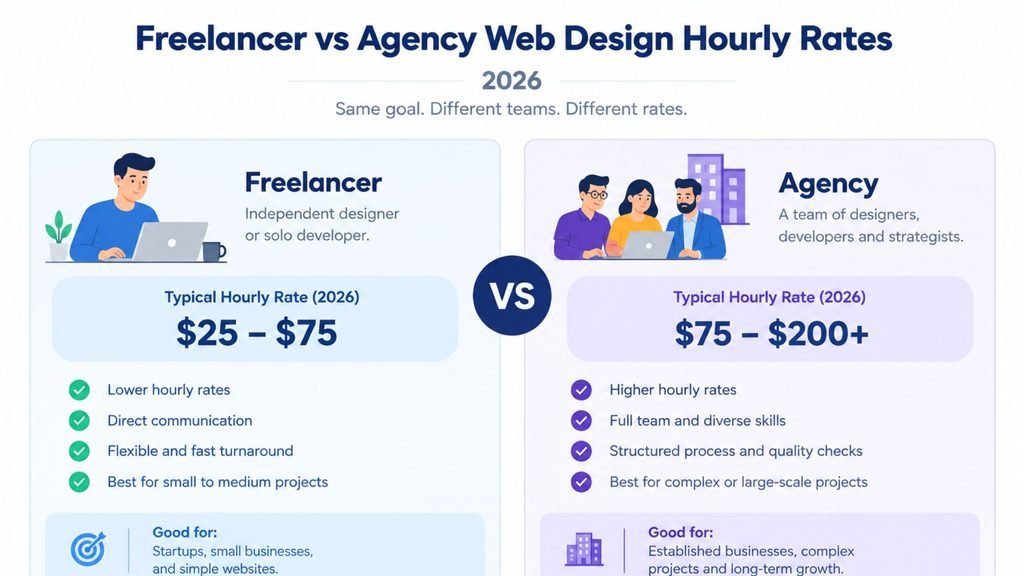
Before building tiers, it helps to know the real range. Freelance web designers commonly charge $25 to $150 an hour depending on experience, with entry-level designers around $25-45/hr, mid-level around $45-85/hr and experienced specialists at $75-150/hr or higher. Design-industry rate data puts US-based agency rates at roughly $100-150/hr on average, with blended agency rates (covering design, development and project management overhead) often running $100-300/hr.
Project-based pricing tells a similar story. Freelance-built sites commonly run $1,500 to $8,000 depending on scope, while agency builds typically start around $5,000 and can reach $30,000 or more for complex work. These numbers track closely with what article #4 found on the buyer side, which makes sense, since they’re describing the same transaction from opposite ends.
| Rate type | Freelancer | Agency |
| Hourly | $25-$150/hr | $75-$300/hr (blended) |
| Per project | $1,500-$8,000 | $5,000-$30,000+ |
| Monthly retainer | $500-$2,500/mo | $1,500-$5,000+/mo |
Building the Starter Tier
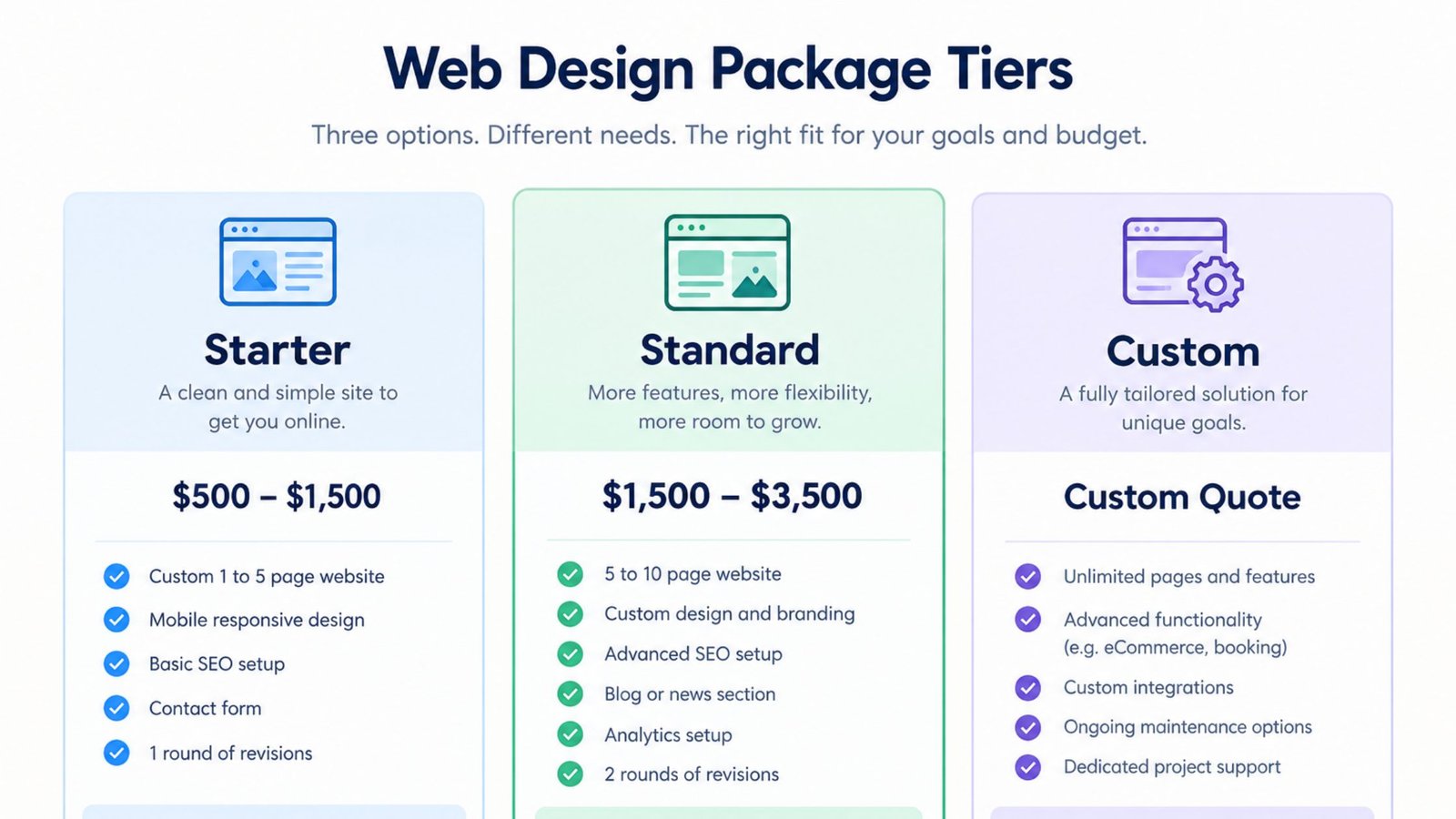
The starter tier is the entry point, a simple site built from a template or a lightly customized theme rather than a from-scratch design. This typically covers three to five pages, basic contact functionality and standard mobile responsiveness, with minimal custom design work.
For a freelancer, this tier commonly prices between $1,500 and $3,000. The value here isn’t the design work itself, it’s the speed and low risk for a client who isn’t sure yet how much website they actually need.
Building the Standard Tier
Standard is where most client budgets actually land. This tier covers a fully custom design rather than a themed template, typically five to ten pages, a contact form with some logic behind it, basic SEO setup and content structured around the client’s actual services rather than generic placeholder copy.
Freelancers commonly price this tier between $3,000 and $8,000, matching the upper half of the general freelance range above. This is usually the tier worth spending the most time describing in a proposal, since it’s where the client is genuinely comparing what’s included, not just the number at the bottom.
Building the Custom Tier
Custom covers everything the other two tiers don’t: ecommerce functionality, custom integrations, membership or booking systems or a page count well past ten. This is where freelance pricing starts overlapping with agency pricing, commonly $8,000 to $25,000 or more depending on exactly what’s involved.
Resist the urge to make this tier vague. “Custom pricing, contact us” tells a client nothing. Listing two or three example scenarios, what a custom ecommerce build typically includes versus a custom booking system, gives the client something concrete to react to even before a real quote is scoped.
Worked Example: Scoping One Project Into Three Tiers
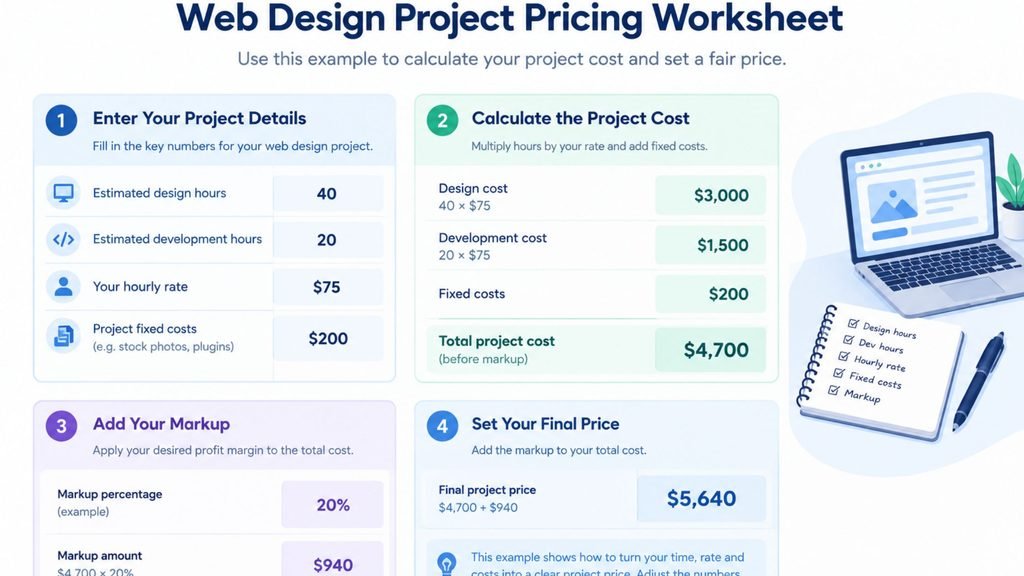
A local contractor wants a new website and isn’t sure what they need. Here’s how one freelancer might structure the options:
| Tier | Includes | Price |
| Starter | 3-page template site, contact form, mobile responsive | $1,800 |
| Standard | 6-page custom design, service pages, basic SEO, gallery | $4,500 |
| Custom | Standard tier plus online booking and review integration | $9,000 |
Presenting all three at once, rather than quoting just the number that seems right, lets the client self-select based on budget and actual need. It’s a far more natural conversation than a single take-it-or-leave-it price.
Presenting Tiers Without Anchoring Too Low
Order matters when a client sees three options side by side. Leading with the starter tier trains a client to think of that number as the baseline, which makes the standard and custom tiers feel like upsells rather than the actual recommended fit. Leading with standard, framing starter as “if budget is the main constraint” and custom as “if scope grows,” keeps the middle tier positioned as the default rather than a compromise.
The same logic applies to how each tier is described. A starter tier described only by what it lacks, no custom design, limited pages, reads as a downgrade. Described by what it’s actually for, a fast, low-risk way to get online while validating a new business, it reads as a genuine option rather than the cheap seat.
Hourly, Project or Retainer: Picking the Right Model
The three tiers above work best as project-based fixed pricing, which is the standard model for most initial web design engagements, since it gives both sides a predictable number.
Hourly billing makes more sense for genuinely open-ended work, ongoing changes, consulting or support where scope isn’t fully known upfront. A monthly retainer fits recurring relationships, regular content updates, small design changes and ongoing maintenance bundled into one predictable fee rather than billed project by project.
Most freelancers end up using two of the three: project pricing for the initial build using tiers like the ones above, then either hourly or retainer for whatever comes after launch. Very few freelancers price everything on one model exclusively, since the initial build and the ongoing relationship genuinely have different risk profiles for both sides.
From Single Estimate to Three Tiers
If you’ve already run the single-estimate version of this tool and have a ballpark scope in mind, build your own three-tier quote from that same scope rather than starting over. The two tools use the same core inputs, pages, features and design complexity, so a number from one feeds naturally into the other.
Freelancers presenting to their own clients can map your scope to a tier directly, using the calculator’s output as a starting point for a real proposal rather than a number pulled from memory.
Common Mistakes When Pricing Web Design
- Quoting one number for every project regardless of scope. A rate that works for a five-page site is either an overcharge for something simpler or a loss on something bigger.
- Making the custom tier too vague to be useful. “Contact us for custom pricing” without any example scope gives a client nothing to anchor to.
- Pricing purely off competitor rates instead of your own costs. A competitor’s number doesn’t account for your overhead. Copying it blind can leave you underpriced without knowing why.
- Never revisiting rates as experience grows. A rate that made sense as a beginner rarely still fits two years and dozens of projects later.
- Skipping maintenance in the initial conversation. A client who’s surprised by an ongoing cost after launch is a client who feels like the pricing wasn’t transparent from the start.
- Treating the three tiers as fixed forever. Rates for each tier should move the same way a single rate would, reviewed at least once a year against current costs and current demand, not set once and left unchanged indefinitely.
FAQs
How much should I charge for web design as a freelancer?
Most freelancers charge $25 to $150 an hour depending on experience or $1,500 to $8,000 per project for a typical small business site. Structuring pricing into starter, standard and custom tiers, rather than one flat number, matches a wider range of client budgets without underpricing complex work.
How do agencies price web design differently than freelancers?
Agencies typically charge more per hour ($75 to $300 blended) and more per project ($5,000 to $30,000 or higher). The price covers a full team rather than one person. Agencies also more commonly bundle strategy, SEO and ongoing support into the quote from the start.
Should I charge hourly or a flat project rate for web design?
Flat project pricing is the standard for most initial builds, since it gives the client a predictable number and rewards you for working efficiently. Hourly billing fits better for open-ended work like ongoing changes or consulting, where the scope genuinely isn’t known upfront.
What should be included in a starter web design package?
A typical starter tier covers three to five pages, a basic contact form and mobile responsiveness, built from a template or lightly customized theme rather than a from-scratch design. It’s priced for speed and low risk, not extensive custom work.
How do I price a custom web design project?
List two or three example scenarios of what “custom” typically includes, ecommerce, bookings, membership systems, rather than leaving the tier as an open-ended “contact us.” Custom project pricing commonly runs $8,000 to $25,000 or more depending on what’s actually involved.
Should web design pricing include ongoing maintenance?
Not usually in the initial build quote. It should be discussed in the same conversation, though. Surprising a client with a maintenance cost after launch, rather than mentioning it upfront, is a common source of client dissatisfaction that has nothing to do with the build price itself.
How do I raise my web design rates without losing existing clients?
Grandfather current clients at their existing rate through the end of their current project or contract term, then apply the new rate to new clients immediately. For long-term recurring clients, give advance notice of an increase rather than changing it mid-cycle. Pair the increase with added value where possible, so the higher number has a clear reason behind it.
One Comment